What Roles does your game support?
White Box introduced the world to this thing we call tabletop role-playing or adventure gaming. White Box uses class to define role in the game. Obviously the roles White Box supports are fighting man, magic user and cleric. If you add Supplement I Greyhawk the additional class and role of thief and the subclass of paladin become available for play. The class system is an easy way to define what roles are expected to play an important part in the type of story that unfolds. Class defines the movers and shakers in the imaginary world and helps the payer know how they fit into the game.
Other games have followed White Box and many use the class system. Each game using the class system provides a similar structure for role-playing even though the classes may differ greatly. Popular early classes that went beyond the White Box three include alchemist, forester and beast master. Inclusion of these roles as player character classes helps to define the type of game likely to be played. In my experience the addition of the thief class has the greatest single effect on White Box and similar systems because it brings into the game a skill system and defines sneaking and stealing as something the game can be about. A campaign based around a thieves guild where everyone plays a thief is probably quite different from one where there are no thief PCs.
It wasn't too long after the White Box taught people about this new hobby of role-playing before a class-less system was created. PCs who are rolled-up or built on a point-buy system without class in the equation allow for virtually any role to be played as a PC. I think it is even more important in a classless system for the referee to have input on the PC make-up because they PCs really shape what the campaign is going to be about. I like several systems that have billed themselves as class-less, but they run the danger of becoming a one-class system if everyone optimizes their PC to the same standard producing virtually the same skill-set. It is easy to end up with everyone playing the same "adventurer" class character.
One of the advantages of White Box was the three classes each had their own strengths and weaknesses, each had a role to play in the adventure that unfolded during play. For some players this seems more important than others. The 4h Edition rules retained traditional class names like fighter and magic user, but redefined roles as Defender, Striker, Controller, etc. I think this is informative and can help players understand the role they are playing in the game while allowing some diversity among the Strikers, etc. so that not all PCs built as Strikers are the same. For some players diversity is more important than others.
I have found diversity can be the background, character and personality I bring to any "generic" PC created with just about any minimal chargen system. There is really no reason for two White Box fighting men PCs to be played the same even though they may be mechanically the same. "Color", "personality", or other ways of describing unique features that may play no mechanical role in the system go beyond the role of class, but can be great fun. There is no better way to bring "life" into a campaign than by thinking of the PCs as "real" people with lives beyond the game. It isn't necessary to do this and many a fun game has been played with two-dimensional PCs. Whether one prefers their PC as simply their playing piece or "pawn" in the game or enjoys fleshing them out, the idea is for everyone to have a role to play in the game and to have fun. There is no "one right way" to do this.
Wednesday, March 30, 2016

Tuesday, March 29, 2016
Inspiration: Red Box

The Spanish RPG Aventuras en La Marca Del Este (Adventures in the East Mark) is a beautiful product both in the original version pictured above and in the English translation version. Both feature the same high quality art as demonstrated by A.J. Manzanedo's red dragon above. The inspiration for Aventuras... is the Red Box version of the World's Most Popular FRPG. In his introduction to the English version of the game author Pedro Gil notes the effect of the original Red Box in inspiring his imagination.
I find inspiration at several levels in this product that has come full circle, being inspired by an American RPG, which in turn inspired a translation from Spanish to English to be sold in America. The artwork throughout both versions of the game and from what I have seen the supplements currently only available in Spanish is astounding and inspires my imagination. Asking myself, who is this warrior, how did he arrive at this point, facing the red dragon whose own history involves what depredations? The shadow figures that adorn the title suggest yet more is to be learned if the whole story be known.
On the first page of the Spanish version of the game, the "creditos", appears the following quote:
"The secret we should never let the gamemasters know is that they don't need any rules." - Gary Gygax.
If they don't need any rules, what is needed?
May I offer - inspiration! Inspiration to tell a good story, to create out of imagination...to borrow, re-frame and adapt. To go beyond experience. To be inspired.
My Ugly Post
Where I Go Negative
I love this hobby, I really do. I am grateful for everything it has given me; hours of enjoyment, dozens of friends, and more. I started this blog to express that (and how much I like the Original Game), so I really try to stick to saying positive things about this hobby. I am breaking with this policy in this post because what I want to say seems important and perhaps may be useful to consider despite the tone (which may seem negative).
One of the reasons I like White Box so much is the choices it presents, the limits to its rules - some might say "gaps" - the result of which is to force the referee to make a number of decisions about the game being played at their table. "Rulings not rules" - this empowers the referee, but can, with a poor referee at the table, lead to a bad game, one in which the players have little fun and perhaps are even taken advantage of. It also means that there is little in the way of standardized play - something Gary Gygax noted and sought to remedy with the Advanced game rules.
Many games written post White Box strive to tighten the loose ends, cover as many possibilities as possible and give players a "complete" set of rules that require no rulings or "making stuff up" on the part of the referee. Some systems are multi-volume with many official supplements together totaling thousands of pages of rules. Often the supplemental rules are exceptions that break the core rules in some circumstances. Much of the supplemental material in some systems seems aimed at increasing PC diversity to the delight of players (and making $$ for the publisher), some of whom seem to never tire of "trying out the latest". The result can be that while the player may know just the rules as they pertain to their PC, the referee using such system either must master all the available material or run a campaign where new rule material is constantly being thrown at them by players, material that may cause the referee to adjust "on the fly" and may in fact not really be to their liking. The result can become a bit like "herding cats" for a referee who tries to accommodate such players.
Rather than let this happen and potentially spoil the fun for all, I think some thought could go into the way a campaign handles their rules. Communication between players and referee about the kind of campaign they will all enjoy together can go a long way towards solving potential issues. The game system choice available today is quite large and it is both easy to find a game system that excites you and difficult to agree on the "best" system for a group. With choice comes diversity. Compromise may be necessary.
I am all for players knowing the rules, although it is certainly possible to have an enjoyable time with a group playing a game which is only well known by the referee, who is teaching the rules by playing. It is only by knowing the rules and mastering them, that players are able to anticipate their odds of success, develop specific strategies and demonstrate skill as players. The game is ultimately a social contract between all who participate and all are entitled to a fun time. A referee who frequently changes the rules during a game can expect to lose players. A rule system that constantly changes the rules with new supplemental materials can expect to lose referees who tire of players who spring something new on them every session. I personally approach every game as if the referee has total right to make it their own... I understand that is a cornerstone of "Old School" play.
The days of everyone in the hobby playing one game are behind us. If we really think about it, even White Box was never one game as each referee ran the game differently. Today the hobby is faced with "an embarrassment of riches", a situation causing problems of its own. Ron Edwards writes an essay, which appears at the end of his game Sorcerer, titled "System Does Matter". He is correct. What matters even more may be that friends agree on what system they will play together. Shared fun is the essence of the hobby, with the emphasis on "shared".
I love this hobby, I really do. I am grateful for everything it has given me; hours of enjoyment, dozens of friends, and more. I started this blog to express that (and how much I like the Original Game), so I really try to stick to saying positive things about this hobby. I am breaking with this policy in this post because what I want to say seems important and perhaps may be useful to consider despite the tone (which may seem negative).
One of the reasons I like White Box so much is the choices it presents, the limits to its rules - some might say "gaps" - the result of which is to force the referee to make a number of decisions about the game being played at their table. "Rulings not rules" - this empowers the referee, but can, with a poor referee at the table, lead to a bad game, one in which the players have little fun and perhaps are even taken advantage of. It also means that there is little in the way of standardized play - something Gary Gygax noted and sought to remedy with the Advanced game rules.
Many games written post White Box strive to tighten the loose ends, cover as many possibilities as possible and give players a "complete" set of rules that require no rulings or "making stuff up" on the part of the referee. Some systems are multi-volume with many official supplements together totaling thousands of pages of rules. Often the supplemental rules are exceptions that break the core rules in some circumstances. Much of the supplemental material in some systems seems aimed at increasing PC diversity to the delight of players (and making $$ for the publisher), some of whom seem to never tire of "trying out the latest". The result can be that while the player may know just the rules as they pertain to their PC, the referee using such system either must master all the available material or run a campaign where new rule material is constantly being thrown at them by players, material that may cause the referee to adjust "on the fly" and may in fact not really be to their liking. The result can become a bit like "herding cats" for a referee who tries to accommodate such players.
Rather than let this happen and potentially spoil the fun for all, I think some thought could go into the way a campaign handles their rules. Communication between players and referee about the kind of campaign they will all enjoy together can go a long way towards solving potential issues. The game system choice available today is quite large and it is both easy to find a game system that excites you and difficult to agree on the "best" system for a group. With choice comes diversity. Compromise may be necessary.
I am all for players knowing the rules, although it is certainly possible to have an enjoyable time with a group playing a game which is only well known by the referee, who is teaching the rules by playing. It is only by knowing the rules and mastering them, that players are able to anticipate their odds of success, develop specific strategies and demonstrate skill as players. The game is ultimately a social contract between all who participate and all are entitled to a fun time. A referee who frequently changes the rules during a game can expect to lose players. A rule system that constantly changes the rules with new supplemental materials can expect to lose referees who tire of players who spring something new on them every session. I personally approach every game as if the referee has total right to make it their own... I understand that is a cornerstone of "Old School" play.
The days of everyone in the hobby playing one game are behind us. If we really think about it, even White Box was never one game as each referee ran the game differently. Today the hobby is faced with "an embarrassment of riches", a situation causing problems of its own. Ron Edwards writes an essay, which appears at the end of his game Sorcerer, titled "System Does Matter". He is correct. What matters even more may be that friends agree on what system they will play together. Shared fun is the essence of the hobby, with the emphasis on "shared".
Thursday, March 24, 2016
dedicated to Gary Gygax and Dave Arneson...
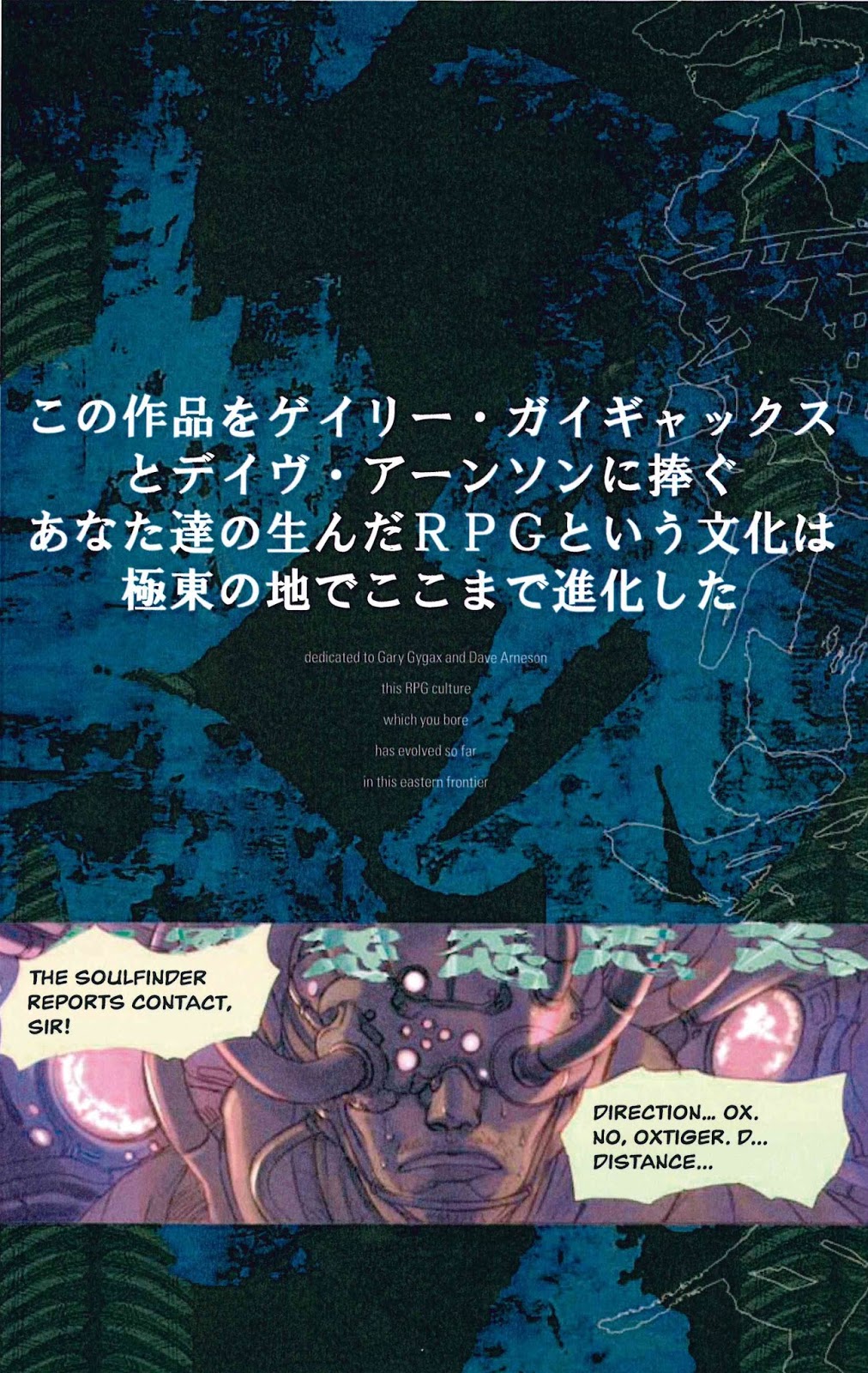
With this dedication author Junichi Inoue acknowledges the contribution of the authors of White Box in his Japanese RPG, Tenra Bansho Zero. The hobby spread internationally not long after White Box and other titles became available. The new hobby, first developed in the Midwest, quickly gained followers across the nation and beyond the American borders. Today we have many fine games developed around the globe and being translated into English from other languages. I consider this a great boon as I am finding many of the translated titles to be very captivating.
Wonderfully translated by Andy Kitkowski who takes extra pains to include extra explanatory text so that those of us not intimately familiar with Japanese culture references can "get it", Tenra Bansho Zero (TBZ) is beautifully illustrated "Hyper Asian Fantasy" (as it bills itself) and a game with revolutionary mechanics sometimes compared to kabuki theater. Written by an Anime artist, TBZ makes use of Japanese Anime and Manga tropes. I think of Ninja Scroll, but there are also giant armors, mannequins and high tech gadgets. TBZ comes as two large volumes and is packed with cultural goodness describing the imaginary world of Tenra. Rules fall into the more narrative style and use a dice pool system.
Ryuutama, written by Atsuhiro Okada and translated by Matt Sanchez and Andy Kitkowski, is another Japanese TRPG (Table-talk Role Playing Game as it refers to the hobby) I really like. Ryuutama is a game about traveling adventure and PCs represent more mundane folks than the heroes found in most RPGs; merchants, farmers, and artisans, rather than fighting men, magic users and clerics. The referee creates and runs the Ryuu (dragon) who sometimes assists, points the way and rewards the party of travelers. Together the players and referee create a story which "feeds the young dragons", keeping the land healthy. The game book is beautifully illustrated and has an environmental theme that runs throughout. It reminds me of Princess Mononoke.
Two Swedish RPGs I find particularly inspiring are Whitehack by Christian Mehrstam and Symbaroum published by Jarnringen, authors Martin Bergstrom, Mattias Johnsson, Anders Lekberg, Mattias Lilja and Johan Nohr. Physically Whitehack and Symbaroum couldn't be more different, but both are packed with great gaming ideas and fantastic settings. Whitehack is a thin 64 page book with a simple character-sheet cover and no interior illustrations - there isn't even a map of the White Curse world, but it isn't missed. Whitehack makes good use of the reader's imagination to visualize the setting. In contrast, Symbaroum is lavishly illustrated with color images on nearly every one of its 264 pages. I like dark fantasy settings and Symbaroum's artwork invokes one of the darkest moods I have seen in gaming books. The setting for the Symbaroum core book is Davokar, a dark forest on the edge of civilization inhabited by hostile elves and worse. It is very rich in detail and definitely not cookie-cutter stuff. Symbaroum uses a unique (to me) d20 system where only the player rolls the dice. The referee takes their cue from the player roll and describes what happens, so it's bit on the narrative side. Whitehack uses two d20's rolled together (similar to 5th Edition) and has a chargen system that I think is genius! There are three classes, Deft, Strong and Wise. Each classes has a number of slots that give the PC special abilities, such as combat abilities or spell abilities. Whitehack classifies species (race), vocation and affiliation as Groups and uses these to greatly individualize the PC. Groups can be virtually anything the player and referee agree to and empower the PC to have advantages (take the higher roll of two d20s) when performing an activity relevant to one of their Groups.
Among the more traditional translated games I have encountered are Aventuras en La Marca del Este (Adventures in the East Mark) by Pedro Gil and friends, and Epees & Sorcellerie (Swords & Sorcerie) by Nicolas Dessaux. Adventures... is a Spanish take on the Red Box version of the World's Most Famous RPG and follows the original pretty well (although there are some changes like the addition of the Paladin and Explorer classes). It is a strong product that comes in a nice box with a referee screen and dice, has excellent artwork, reads well and includes an original setting, the "East Mark", that I find very engaging. Epees... uses a 2d6 system and is not a direct clone, but has a strong White Box feel about it, although with a bit less Tolkien and a bit more sword & sorcery. Epees draws on the Chainmail rules as well as White Box and the OSR in general to create a game with its own feel. Comparing it to White Box, I find Epees illustrative of the subtle ways rule changes can influence implied setting.
I have not had the privilege of gaming with a group outside my own country, but I am very encouraged for the hobby by the things I read on the web and the games I have come in contact with that originate outside the United States. The hobby seems to be thriving beyond North America and many good ideas and games are coming in as well as going out these days. I think Gary and Dave would be pleased.
Tuesday, March 22, 2016
Resource Management
Torches, Rations, Hit Points, and Spell Slots
White Box is a game of managing limited resources as much as it is about adventure, discovery and treasure acquisition. Hand waving the resources can break major links with reality and make the whole experience seem less real. Managing scarce resources can also add an element of tension that may otherwise be lacking, tension that heightens excitement and ultimately, enjoyment.
One of the things I enjoy about reading (and playing) some of the indie RPGs is they often help me bring aspects of the hobby into more clear focus. Torchbearer by Thor Olavsrud and Luke Crane (The Burning Wheel) is a thought-provoking dungeon crawl game that brings into focus the need to manage the resources and condition of one's party of adventurers. White Box was certainly designed with dungeon crawling in mind and although it does much more than facilitate dungeon adventure, the dungeon is perhaps the easiest environment for a referee due to its limited scope.
In order to succeed at White Box dungeon crawling, the party of adventurers have a set of tools including items purchased or acquired, such as food, torches, potions, etc. and expendable aspects of the individual character that are not unlimited, such as hit points and spells that can be cast. The idea is to enter the dungeon, grab as much wealth and experience as possible during the time the resources hold out and get back to safety in order to reap the benefits of their accomplishments. A skillful referee may add some mystery to unravel giving the party reasons to go into the underworld other than treasure and experience, but at its most basic it's pretty simple fun. The challenge is to work together, be smart about getting the treasure and managing the resources to maximize profit.
In order to build tension and excitement, the referee needs to track the passage of in-game time carefully. Using up torches and other sources of light, consuming food and water, tracking healing and other health conditions and recharging of spells all requires accounting for time in a fair manner. There aren't many monsters that can cause terror as easily as the prospect of a party plunged into darkness from which they have no ready remedy.
Resources are important when traveling across the wilderness as well. Again I am reminded of a game that particularly highlights this aspect of the hobby, but it applies to White Box and most other RPGs as well. Ryuutama (Dragon-egg) by Atsuhiro Okada and translated from Japanese by Matt Sanchez and Andy Kitkowski, is a delightful RPG about travel in a medieval-esque landscape where the journey is the story. Ryuutama makes sleep, weather, terrain and equipment such as clothing and footwear (often taken for granted) all important resources to be managed along the journey. It does so smoothly and in a manner that incorporates it all into the "story" rather than making it a bookkeeping chore. Ryuutama is one of those games that have changed my attitude about some aspect of gaming and is likely to influence how I referee all other games.
The positive outcome of resource management is that of adding depth and flavor to the game. The resources seem real and helps connect the game-play with reality. We can all identify with being sleepy, hungry or in the dark. Managing certain resources add to the verisimilitude as long as it is handled in a quick, easily understood manner that has realistic consequences. Some players may even find a new calling as "party quartermaster".
White Box is a game of managing limited resources as much as it is about adventure, discovery and treasure acquisition. Hand waving the resources can break major links with reality and make the whole experience seem less real. Managing scarce resources can also add an element of tension that may otherwise be lacking, tension that heightens excitement and ultimately, enjoyment.
One of the things I enjoy about reading (and playing) some of the indie RPGs is they often help me bring aspects of the hobby into more clear focus. Torchbearer by Thor Olavsrud and Luke Crane (The Burning Wheel) is a thought-provoking dungeon crawl game that brings into focus the need to manage the resources and condition of one's party of adventurers. White Box was certainly designed with dungeon crawling in mind and although it does much more than facilitate dungeon adventure, the dungeon is perhaps the easiest environment for a referee due to its limited scope.
In order to succeed at White Box dungeon crawling, the party of adventurers have a set of tools including items purchased or acquired, such as food, torches, potions, etc. and expendable aspects of the individual character that are not unlimited, such as hit points and spells that can be cast. The idea is to enter the dungeon, grab as much wealth and experience as possible during the time the resources hold out and get back to safety in order to reap the benefits of their accomplishments. A skillful referee may add some mystery to unravel giving the party reasons to go into the underworld other than treasure and experience, but at its most basic it's pretty simple fun. The challenge is to work together, be smart about getting the treasure and managing the resources to maximize profit.
In order to build tension and excitement, the referee needs to track the passage of in-game time carefully. Using up torches and other sources of light, consuming food and water, tracking healing and other health conditions and recharging of spells all requires accounting for time in a fair manner. There aren't many monsters that can cause terror as easily as the prospect of a party plunged into darkness from which they have no ready remedy.
Resources are important when traveling across the wilderness as well. Again I am reminded of a game that particularly highlights this aspect of the hobby, but it applies to White Box and most other RPGs as well. Ryuutama (Dragon-egg) by Atsuhiro Okada and translated from Japanese by Matt Sanchez and Andy Kitkowski, is a delightful RPG about travel in a medieval-esque landscape where the journey is the story. Ryuutama makes sleep, weather, terrain and equipment such as clothing and footwear (often taken for granted) all important resources to be managed along the journey. It does so smoothly and in a manner that incorporates it all into the "story" rather than making it a bookkeeping chore. Ryuutama is one of those games that have changed my attitude about some aspect of gaming and is likely to influence how I referee all other games.
The positive outcome of resource management is that of adding depth and flavor to the game. The resources seem real and helps connect the game-play with reality. We can all identify with being sleepy, hungry or in the dark. Managing certain resources add to the verisimilitude as long as it is handled in a quick, easily understood manner that has realistic consequences. Some players may even find a new calling as "party quartermaster".
Thursday, March 17, 2016
White Box Combat and Beyond
The Rest of the Story...
White Box provides rules for combat, moving, surprise, encountering monsters, really all the things one might expect given its wargame roots and dungeon crawl setting. When the main in-game activity is exploring an underground, fighting hostile "monsters" and grabbing their treasure in order to "level-up" between dungeon delves, combat is perhaps the most important activity. What White Box doesn't give are rules for interacting with NPCs. Well, there is the Loyalty Base Charisma modifier, but that is about it. The rest is role-play.
Playing White Box, it won't be long before some enterprising player will propose to "trick the monster out of his treasure rather than risk a fight". Enter role-playing. Some games give extensive rules for social interaction, some I enjoy like Luke Crane's The Burning Wheel. Other games seem to go half-way allowing for social skills like "persuasion" and "diplomacy" which can be rolled against in order to change an NPC's mind about something. White Box leaves all that "talking stuff" up to the players and referee to actually "talk out".
Skill-based systems include many "skill" activities other than those involved with social interaction. White Box doesn't have "skills", but the idea does show up in Supplement I Greyhawk under the Thief class abilities. The same concepts covered by "skills" in some systems can be handled by discussion between player and referee followed by a die roll if deemed necessary. I personally favor allowing players to state their PC should have some skill in the area because of something specific to the PC's background. If the argument sounds reasonable, I allow it as referee.
There are no rules in White Box for backgrounds or personality traits beyond alignment, which I see as more "what team one plays for" rather than as a definition of personality (although it certainly can be used that way). It's White Box, so alignment is also open for interpretation. Putting alignment aside, personality can develop through play as players "get to know their PCs" through their in-game actions, or personality can follow a preconceived character concept. Backgrounds can be briefly stated or written out extensively. Often a few words are sufficient. "Born on a farm and ran away to sea at the age of 14." gives one a pretty fair idea of a PC background.
In White Box it is perfectly acceptable to hand-wave all pretense at fleshing out the PC and playing the game with characters as little more than a series of stats on paper and a marker on the game table for spacial reference, similar to a ship in a naval wargame. It's also possible to bring the imagination into play and mentally construct a fully rounded avatar or alter ego for play. White Box encourages making the game your own, expanding where you like and that's one of the things I like best about it.
White Box provides rules for combat, moving, surprise, encountering monsters, really all the things one might expect given its wargame roots and dungeon crawl setting. When the main in-game activity is exploring an underground, fighting hostile "monsters" and grabbing their treasure in order to "level-up" between dungeon delves, combat is perhaps the most important activity. What White Box doesn't give are rules for interacting with NPCs. Well, there is the Loyalty Base Charisma modifier, but that is about it. The rest is role-play.
Playing White Box, it won't be long before some enterprising player will propose to "trick the monster out of his treasure rather than risk a fight". Enter role-playing. Some games give extensive rules for social interaction, some I enjoy like Luke Crane's The Burning Wheel. Other games seem to go half-way allowing for social skills like "persuasion" and "diplomacy" which can be rolled against in order to change an NPC's mind about something. White Box leaves all that "talking stuff" up to the players and referee to actually "talk out".
Skill-based systems include many "skill" activities other than those involved with social interaction. White Box doesn't have "skills", but the idea does show up in Supplement I Greyhawk under the Thief class abilities. The same concepts covered by "skills" in some systems can be handled by discussion between player and referee followed by a die roll if deemed necessary. I personally favor allowing players to state their PC should have some skill in the area because of something specific to the PC's background. If the argument sounds reasonable, I allow it as referee.
There are no rules in White Box for backgrounds or personality traits beyond alignment, which I see as more "what team one plays for" rather than as a definition of personality (although it certainly can be used that way). It's White Box, so alignment is also open for interpretation. Putting alignment aside, personality can develop through play as players "get to know their PCs" through their in-game actions, or personality can follow a preconceived character concept. Backgrounds can be briefly stated or written out extensively. Often a few words are sufficient. "Born on a farm and ran away to sea at the age of 14." gives one a pretty fair idea of a PC background.
In White Box it is perfectly acceptable to hand-wave all pretense at fleshing out the PC and playing the game with characters as little more than a series of stats on paper and a marker on the game table for spacial reference, similar to a ship in a naval wargame. It's also possible to bring the imagination into play and mentally construct a fully rounded avatar or alter ego for play. White Box encourages making the game your own, expanding where you like and that's one of the things I like best about it.
Wednesday, March 16, 2016
Tower of the Dead

Perilous Lands' Site Book describes fifteen locations in detail and mentions two others, one of these is the Tower of the Dead (Tower). The Tower comes in a very thin box with a nice cover illustration on the front showing the main baddie on his throne and a color map of the adventure area on the back of the box. Using the back of the box this way is an interesting concept I have not seen on another product. Inside the box is a tri-fold referee screen with specific information for Tower and a 56 page adventure book.
Tower is what I call an "adventure path" in today's vernacular. It tells a story in several scenes scattered about several locations. It involves interaction with a number of PCs, some investigative work and several decisions on the part of the players to continue down the path. It's not exactly rail-roadie, there are choices, but choosing to get off the path usually means the referee is in improvisation mode. "Adventure paths" are common these days, but probably less so in 1984 when this product was published.
Written by Powers & Perils author Richard Snider, Tower is firmly grounded in both the P&P system and the default Perilous Lands setting. Tower begins in the city of Porta where the local gangs openly battle for dominance - reminds me of the Al Capone era in Chicago. If the players go along with the story arch they will be drawn into some bad dealings - beatings and murder. If they take the moral high road, it's improvisation time for the referee. on the positive, the gangs and NPCs are all described in some detail giving the referee plenty to work with. I can't help but wonder what playing one gang off against another (Yojimbo, Fistful of Dollars, Last Man Standing) might be like.
Eventually information will lead the PCs to a farm outside town and an opportunity to acquire an ancient sword that can be helpful. They will also learn of an ancient evil in the form of a powerful lich that threatens to "take over the world". If they accept the challenge to "save the world" they move on to the tower where said lich resides plotting his evil. From this point on it's a tower crawl.
The other location mentioned in Perilous Lands is Doom Manor which was printed in Heroes magazine Vol. 1 No. 2. Doom Manor is a haunted house adventure with a twist...the house itself is sentient evil and actively trying to destroy the PCs. Heroes magazine printed several useful articles related to P&P, including Vol. 1 No. 1 which has a history/traveler's guide of the country of Donara and Vol. 1 No. 5 which has a nice lengthy article on the Royal City of Donara. Taken together the published material available for P&P is enough to run a lengthy campaign, maybe lasting years. The P&P world setting and adventure ideas seem to compare nicely with more modern products and I wonder how influential this body of work has been in the hobby.
Subscribe to:
Posts (Atom)