Deserves A Second Look
Recently I have been getting reacquainted with one of my favorite out-of-print FRPGs, the highly detailed Powers & Perils, and once again I am impressed with finding aspects of the game that are ahead of its time and generally useful as a borrowed mechanic for play using other systems. Powers & Perils is a game introduced in 1983 by the Avalon Hill Game Company alongside RuneQuest 3rd Edition and Lords of Creation in an effort to leverage some of the growing popularity of fantasy role-play games. Powers & Perils is written by Richard Snider who was involved with David Arneson during the Blackmoor days and together with Mr. Arneson designed the previous FRPG Adventures in Fantasy (1978).
Avalon Hill Powers & Perils core rules consist of a boxed set of five paperback volumes. They are titled The Character Book (44 pages), The Combat and Magic Book (52 pages), The Creature Book (60 pages), The Book of Human Encounters and Treasures (52 pages), and County Modara (24 pages). A version 2 of P&P (in a single 471 page volume) and its setting Perilous Lands (544 pages) is available digitally and P&P is still a good game. Once described as over priced and complex (some math required) back in the day, I currently find P&P neither. P&P v2 is a free download and its mechanics do not seem complex by today's standards. The popular RPGs GURPS and Champions/Hero System both involve more math during character generation than P&P.
Powers & Perils (P&P) is a roll under d100 system. Skill and combat rolls in P&P are resolved using a system that accounts for "partial success", that is rolling over the target number, but being within 21% points over is considered a partial success allowing for various in-game effects which are less than a total success but greater than a total failure. The mechanics of many d100 systems can benefit from use of such an interpretation of the dice. Recent editions of Warhammer Fantasy Roll Play (4e) and Call of Cthulhu (7e) both make use of a similar philosophy. WFRP 4e uses success levels and CoC 7e refers to regular success, hard success and extreme success.
A partial skill roll success is also possible and earns experience points for the character. Combat in P&P uses a matrix comparing Offensive Combat Value (OCV) to Defensive Combat Value, (DCV) the difference producing a value which is translated into a percentile skill test in which you roll equal to or under the target number for success. A partial success in combat results in a shield hit, provided the target has one. Use of an offensive and defensive value computed during chargen is used in Hero System and Rolemaster games and although it involves a bit of subtraction, it can add to the feeling of realism in my experience.
Mr. Snider has an approach to game settings and milieu which I especially like. Even as far back as that described in Adventures in Fantasy, I found his implied setting captivating. Alignment in P&P is an exceptional concept in gaming. Drawing on the conflict between the forces of Law and Chaos that is found in White Box P&P adds additional layers of conflict consisting of the agendas of several elder races and other worldly beings. Thus alignment in the Perilous Lands is which side are you fighting for as well as a determinate of behavioral attitudes and perhaps a moral compass.
The surface and underworld encounter tables found in Powers & Perils creature book are quite good (some of the best I have seen) and are useful both as an example and as is in many settings. The implied setting of Powers & Perils (The Perilous Lands) involves three distinct "planes", the middle world which is similar to our own Earth in climate, physics and calendar, the lower world of darkness and faerie and the upper world of angels and heavenly creatures. Mr. Snider's take on dwarves, elves and faerie in general gives them a strange and exotic personality very distinct from humans which I find has its own appeal. The middle world contains many connections to the underworld and over world which facilitates "invasions" of nonhuman creatures and exploration/adventuring by player characters who pass through the "portals". A typical "portal" might be a forest glen or cave which "transports" those of the middle world who enter it to the lower world of dark faerie.
Powers & Perils is a game that impresses me each time I spend time with it. It has a system and setting which have influenced my attitudes and preferences. I have frequently drawn upon its material for use in other games and settings and found many of the borrowed ideas taken from the P&P boxed set to be quite satisfying in play. I am wondering why I haven't done more with P&P than read the system materials, borrow from them and roll up a few characters?
Being the observations, recollections and occasional ramblings of a long-time tabletop gamer.
Thursday, February 28, 2019
Wednesday, February 27, 2019
Powered by Labyrinth Lord
Return to the Underworld
First published in 2007, early on in the Old School movement, Labyrinth Lord by Goblinoid Games is a faithful clone of the popular B/X system combing material that was split into two books in the originals (levels 1-3 as covered in Basic with levels 4-14 as covered in Expert). B/X was TSR's second take on the Basic Rules and was the work of editor Tom Moldvay. It was published in 1981, three years after the J. Eric Holmes version of Basic, and was soon followed by the Expert Rules edited by David Cook with Steve Marsh. B/X continued the design philosophy of the Original Edition and is considered by many to hit the sweet spot in terms of usability. B/X was well supported with some very good Basic and Expert modules and remains a fan favorite version of the game. Using the SRD and OGL Labyrinth Lord provides a means of publishing new materials without copyright infringement and there are a number of good supplements and modules written by LL author Daniel Proctor and others.
In 2008 Mr. Proctor dialed back the clock to 1974 and gave us Original Edition Characters for use with Labyrinth Lord. Original Edition Characters presents options that reproduce a style of game that resembles the Original Edition in terms of ability score bonuses and prime requisites, and limiting players to the original three classes, Clerics, Magic Users and Fighting Men, but also takes some departures from White Box. Labyrinth Lord treats dwarves, elves and halflings as their own class and this remains so in Original Edition Characters. Elves are treated as choosing to act as a Magic User or Fighting Man in any particular adventure in amanner similar to one interpretation of White Box elves. The spell lists also differ from that found in the three Little Brown Books. For example Magic Missile, a spell added in Supplement I Greyhawk, is included in Original Edition Characters. Original Edition Characters uses variable hit dice, d8 for Fighting Men, d6 for Clerics and Magic Users, which differs from the White Box which uses d6 rolls for determining hit points and from Supplement I which introduces variable hit dice, but uses a d4 for the Magic User class. Combat is unchanged from Labyrinth Lord.
Daniel Proctor took Labyrinth Lord a step further in 2010 with his Advanced Edition Companion which adds some of the classes, races, monsters and treasures found in the first edition Advanced Game to the Labyrinth Lord line. Armed with Labyrinth Lord and the Advanced Edition Companion gamers and developers have an in print open license system to use. Labyrinth Lord seems well received and there are a number of products written with it in mind. In 2018 Mr. Proctor combined the Labyrinth Lord and Advanced Edition Companion under a single cover titled Advanced Labyrinth Lord.
Barrowmaze Complete is a Labyrinth Lord compatible megadungeon by Greg Gillespie. By extension, products designed using Labyrinth Lord mechanics can easily be used with most old school renaissance systems as they generally share many common themes. One will notice both the Labyrinth Lord and OSR labels can be found on the cover of Barrowmaze Complete and other products which indicate they are written to be used with those games.
The Forbidden Caverns of Archaia is a second megadungeon also compatible with Labyrinth Lord and also written by Greg Gillespie. The megadungeon format dates back to the original campaigns of the authors of the Original Role-Playing Game, the White Box. Consisting of multiple levels, each becoming more challenging as they go deeper and often organized around a theme, the megadungeon forms the basis for an entire campaign of extended play, often seeing the rise to power of the players' characters as they adventure in the depth of the underground, defeating monsters, foiling sinister plots and liberating lost treasures. B/X, and by extension Labyrinth Lord, is considered well suited to the dungeon based adventure.
A game as popular as Labyrinth Lord is able to spin off many associated products including its own Referee Screen. The practice of using a referee screen dates back to the earliest days of the hobby, although the original game didn't come with one (a pamphlet of charts and tables was included instead) and it was several years before TSR issued an "official" version of the referee screen. The barrier is to screen the referee's maps and notes from the players' view so as to not prematurely reveal surprises the referee may have planned. Many referees roll dice behind the screen, but as I have stated previously, I see no good reason to do this. (Just turn the map over or close the book when not consulting it.) As a matter of preference, I seldom set a screen up to shield anything from view, although I do find the information contained on many screens to be of use as a quick reference to consult during the game.
Labyrinth Lord, together with OSRIC and Swords & Wizardry ushered in the Old School Renaissance by providing the hobby with a way to produce and market new material written for use with older out-of-print editions of the Worlds Most Popular Role-Playing Game. I could say it/they powered a revolution in the game industry. Certainly the hobby has been impacted as new product became available and there has been renewed interest among older grognards and new gamers who are discovering the older editions for the first time through the OSR. Wizbros has re-released a large number of the older editions and play aids in digital and print formats and almost certainly has incorporated OSR elements into the 5th Edition released in 2014. Today, interest remains strong in the games released during the early days of the hobby and there is perhaps more people today interested in the games than ever before as evidenced by the online presence and availability of product offerings.
First published in 2007, early on in the Old School movement, Labyrinth Lord by Goblinoid Games is a faithful clone of the popular B/X system combing material that was split into two books in the originals (levels 1-3 as covered in Basic with levels 4-14 as covered in Expert). B/X was TSR's second take on the Basic Rules and was the work of editor Tom Moldvay. It was published in 1981, three years after the J. Eric Holmes version of Basic, and was soon followed by the Expert Rules edited by David Cook with Steve Marsh. B/X continued the design philosophy of the Original Edition and is considered by many to hit the sweet spot in terms of usability. B/X was well supported with some very good Basic and Expert modules and remains a fan favorite version of the game. Using the SRD and OGL Labyrinth Lord provides a means of publishing new materials without copyright infringement and there are a number of good supplements and modules written by LL author Daniel Proctor and others.
In 2008 Mr. Proctor dialed back the clock to 1974 and gave us Original Edition Characters for use with Labyrinth Lord. Original Edition Characters presents options that reproduce a style of game that resembles the Original Edition in terms of ability score bonuses and prime requisites, and limiting players to the original three classes, Clerics, Magic Users and Fighting Men, but also takes some departures from White Box. Labyrinth Lord treats dwarves, elves and halflings as their own class and this remains so in Original Edition Characters. Elves are treated as choosing to act as a Magic User or Fighting Man in any particular adventure in amanner similar to one interpretation of White Box elves. The spell lists also differ from that found in the three Little Brown Books. For example Magic Missile, a spell added in Supplement I Greyhawk, is included in Original Edition Characters. Original Edition Characters uses variable hit dice, d8 for Fighting Men, d6 for Clerics and Magic Users, which differs from the White Box which uses d6 rolls for determining hit points and from Supplement I which introduces variable hit dice, but uses a d4 for the Magic User class. Combat is unchanged from Labyrinth Lord.
Daniel Proctor took Labyrinth Lord a step further in 2010 with his Advanced Edition Companion which adds some of the classes, races, monsters and treasures found in the first edition Advanced Game to the Labyrinth Lord line. Armed with Labyrinth Lord and the Advanced Edition Companion gamers and developers have an in print open license system to use. Labyrinth Lord seems well received and there are a number of products written with it in mind. In 2018 Mr. Proctor combined the Labyrinth Lord and Advanced Edition Companion under a single cover titled Advanced Labyrinth Lord.
Barrowmaze Complete is a Labyrinth Lord compatible megadungeon by Greg Gillespie. By extension, products designed using Labyrinth Lord mechanics can easily be used with most old school renaissance systems as they generally share many common themes. One will notice both the Labyrinth Lord and OSR labels can be found on the cover of Barrowmaze Complete and other products which indicate they are written to be used with those games.
The Forbidden Caverns of Archaia is a second megadungeon also compatible with Labyrinth Lord and also written by Greg Gillespie. The megadungeon format dates back to the original campaigns of the authors of the Original Role-Playing Game, the White Box. Consisting of multiple levels, each becoming more challenging as they go deeper and often organized around a theme, the megadungeon forms the basis for an entire campaign of extended play, often seeing the rise to power of the players' characters as they adventure in the depth of the underground, defeating monsters, foiling sinister plots and liberating lost treasures. B/X, and by extension Labyrinth Lord, is considered well suited to the dungeon based adventure.
A game as popular as Labyrinth Lord is able to spin off many associated products including its own Referee Screen. The practice of using a referee screen dates back to the earliest days of the hobby, although the original game didn't come with one (a pamphlet of charts and tables was included instead) and it was several years before TSR issued an "official" version of the referee screen. The barrier is to screen the referee's maps and notes from the players' view so as to not prematurely reveal surprises the referee may have planned. Many referees roll dice behind the screen, but as I have stated previously, I see no good reason to do this. (Just turn the map over or close the book when not consulting it.) As a matter of preference, I seldom set a screen up to shield anything from view, although I do find the information contained on many screens to be of use as a quick reference to consult during the game.
Labyrinth Lord, together with OSRIC and Swords & Wizardry ushered in the Old School Renaissance by providing the hobby with a way to produce and market new material written for use with older out-of-print editions of the Worlds Most Popular Role-Playing Game. I could say it/they powered a revolution in the game industry. Certainly the hobby has been impacted as new product became available and there has been renewed interest among older grognards and new gamers who are discovering the older editions for the first time through the OSR. Wizbros has re-released a large number of the older editions and play aids in digital and print formats and almost certainly has incorporated OSR elements into the 5th Edition released in 2014. Today, interest remains strong in the games released during the early days of the hobby and there is perhaps more people today interested in the games than ever before as evidenced by the online presence and availability of product offerings.
Friday, February 22, 2019
Advanced Rules Cloning
OSR Beginning and Beyond
As I understand it, the Old School Renaissance is the outgrowth of various online forum discussions. One of the first (maybe the actual first?) publication to come out of this revival/interest in the older game(s) is OSRIC (Old School Reference and Index Compilation) created by Stuart Marshall and Matthew Finch in 2006 under the Open Gaming License (OGL) using a System Reference Document (SRD). The stated purpose of OSRIC, and by extension many OSR retro-clones, is to allow publishers to produce new material for the Advanced Game (also compatible with Basic and White Box as well). The print on demand services allow for hard copies of OSRIC to be purchased for use at the table as well as OSRIC being available in its original digital format.
OSRIC, now in its second edition, cleans up and reorganizes the Advanced system and in some ways is a more usable product than the original. OSRIC drops some of the complicating rule bits that most in the hobby, myself included, exclude from play such as the weapon verses armor class matrix. If I am asked about someone new getting into the Advanced Game, I shall say, go get OSRIC for use at the table, but read the original for that period "Gygaxian" feel. Mr. Gygax put a lot of himself into the original Advanced Edition volumes (especially the DM Guide) and his writing voice should be experienced by any serious student of the game.
Soon after the publication of OSRIC and retro-clones of Basic, White Box, Holmes and the other originals, several OSR enthusiasts reinterpreted the older games, adding new ideas and produced essentially new games based on the original system concepts. Thus we now have what may be called the second generation OSR games. Joseph Bloch of BRW Games has designed his version of Advanced beyond 1e. Adventures Dark & Deep is his interpretation of what a second edition of Advanced might have looked like had Gary Gygax written 2e (or had more influence on it). Drawing from articles, subsequent games written by Mr. Gygax after he left TSR, the online postings of Mr. Gygax, and Mr. Gygax's Unearthed Arcana (TSR), Adventures Dark & Deep is based on, and perhaps reflects much of, the post 1e thinking of the original Advanced game author. Additional character classes (heavily influenced by UA), spells, monsters and treasures and some streamlining of the rules is added, all whilst retaining the feel of the first edition. Therefore Adventures Dark & Deep gives the OSR audience a nice "what if" product that takes the game beyond 1e. I find Adventures Dark & Deep much to my liking and the excellent Castle of the Mad Archmage mega dungeon is quite compelling. I have yet to run Adventures Dark & Deep, but I hope to do so someday...soon!
Astonishing Swordsmen & Sorcerers of Hyperborea, published by North Wind Adventures, is an awesome game based on the 1e system, but with an emphasis on a more swords & sorcery feel. Written by Jeff Talanian who worked alongside Mr. Gygax in his later years on such projects as Castle Zagyg, Astonishing Swordsmen is set in Mr. Talanian's Hyperborea setting (likely named after a fictional setting of author Clark Aston Smith) which strikes me as one of the most engaging published settings I have had the good fortune to encounter. Hyperborea and the Astonishing Swordsmen rules are both rich in a swords & sorcery tone, one which I have enjoyed since first discovering R.E. Howard's Conan stories (my reading of Clark Ashton Smith came later). I have not had the pleasure of playing at Mr. Talanian's table (although I understand he runs a number of convention sessions, so maybe someday?), but I have enjoyed several Astonishing Swordsmen convention games set in his setting of Hyperborea and I have refereed a short campaign of my own in Hyperborea, finding it engaging and fun to run.
Goodman Games produces some of the best adventure modules written to date under the marketing slogan, "first edition feel!" and in 2012 they added their own entry into the OSR rules system field. The Dungeon Crawl Classics Role Playing Game, written by company owner Joseph Goodman, borrows concepts from older systems such as race-as-class and also from newer systems such as the ascending AC, fortitude, reflex and willpower saves, and combines them with new system material inspired by Mr. Goodman's extensive research into Appendix N (DM Guige 1e) to create a modern masterpiece. The DCC game is well supported both by the publisher and by several third party entities and has a unique, fun flavor that is fresh and challenging (in a good way). In the last two years I have played in, and refereed, more DCCRPG sessions than those of any other system. That should give you, dear reader, a good indication of my positive feelings for this game.
As I understand it, the Old School Renaissance is the outgrowth of various online forum discussions. One of the first (maybe the actual first?) publication to come out of this revival/interest in the older game(s) is OSRIC (Old School Reference and Index Compilation) created by Stuart Marshall and Matthew Finch in 2006 under the Open Gaming License (OGL) using a System Reference Document (SRD). The stated purpose of OSRIC, and by extension many OSR retro-clones, is to allow publishers to produce new material for the Advanced Game (also compatible with Basic and White Box as well). The print on demand services allow for hard copies of OSRIC to be purchased for use at the table as well as OSRIC being available in its original digital format.
OSRIC, now in its second edition, cleans up and reorganizes the Advanced system and in some ways is a more usable product than the original. OSRIC drops some of the complicating rule bits that most in the hobby, myself included, exclude from play such as the weapon verses armor class matrix. If I am asked about someone new getting into the Advanced Game, I shall say, go get OSRIC for use at the table, but read the original for that period "Gygaxian" feel. Mr. Gygax put a lot of himself into the original Advanced Edition volumes (especially the DM Guide) and his writing voice should be experienced by any serious student of the game.
Soon after the publication of OSRIC and retro-clones of Basic, White Box, Holmes and the other originals, several OSR enthusiasts reinterpreted the older games, adding new ideas and produced essentially new games based on the original system concepts. Thus we now have what may be called the second generation OSR games. Joseph Bloch of BRW Games has designed his version of Advanced beyond 1e. Adventures Dark & Deep is his interpretation of what a second edition of Advanced might have looked like had Gary Gygax written 2e (or had more influence on it). Drawing from articles, subsequent games written by Mr. Gygax after he left TSR, the online postings of Mr. Gygax, and Mr. Gygax's Unearthed Arcana (TSR), Adventures Dark & Deep is based on, and perhaps reflects much of, the post 1e thinking of the original Advanced game author. Additional character classes (heavily influenced by UA), spells, monsters and treasures and some streamlining of the rules is added, all whilst retaining the feel of the first edition. Therefore Adventures Dark & Deep gives the OSR audience a nice "what if" product that takes the game beyond 1e. I find Adventures Dark & Deep much to my liking and the excellent Castle of the Mad Archmage mega dungeon is quite compelling. I have yet to run Adventures Dark & Deep, but I hope to do so someday...soon!
Astonishing Swordsmen & Sorcerers of Hyperborea, published by North Wind Adventures, is an awesome game based on the 1e system, but with an emphasis on a more swords & sorcery feel. Written by Jeff Talanian who worked alongside Mr. Gygax in his later years on such projects as Castle Zagyg, Astonishing Swordsmen is set in Mr. Talanian's Hyperborea setting (likely named after a fictional setting of author Clark Aston Smith) which strikes me as one of the most engaging published settings I have had the good fortune to encounter. Hyperborea and the Astonishing Swordsmen rules are both rich in a swords & sorcery tone, one which I have enjoyed since first discovering R.E. Howard's Conan stories (my reading of Clark Ashton Smith came later). I have not had the pleasure of playing at Mr. Talanian's table (although I understand he runs a number of convention sessions, so maybe someday?), but I have enjoyed several Astonishing Swordsmen convention games set in his setting of Hyperborea and I have refereed a short campaign of my own in Hyperborea, finding it engaging and fun to run.
Goodman Games produces some of the best adventure modules written to date under the marketing slogan, "first edition feel!" and in 2012 they added their own entry into the OSR rules system field. The Dungeon Crawl Classics Role Playing Game, written by company owner Joseph Goodman, borrows concepts from older systems such as race-as-class and also from newer systems such as the ascending AC, fortitude, reflex and willpower saves, and combines them with new system material inspired by Mr. Goodman's extensive research into Appendix N (DM Guige 1e) to create a modern masterpiece. The DCC game is well supported both by the publisher and by several third party entities and has a unique, fun flavor that is fresh and challenging (in a good way). In the last two years I have played in, and refereed, more DCCRPG sessions than those of any other system. That should give you, dear reader, a good indication of my positive feelings for this game.
Tuesday, February 19, 2019
Hit Points Reconsidered
Damage and Health...and Courage and Resolve?
What do Hit Points represent? We have been asking that question since the earliest days of the hobby. I have recently heard Tim Kask give his explanation on his YouTube channel, The Curmudgeon in the Cellar. Mr. Kask indicates that hit points represent the ability to avoid a killing blow. The loss of hit points represents tricks that work once, but that seldom work twice, special defensive moves, and other advantages learned and perfected through experience, all of which can be used up during encounters. According to Mr. Kask, only the last bit of damage that puts the PC down actually damages the body of the character. Monsters may be different and damage to a large monster may mean actually slicing them up.
I have typically narrate various damage effects such as the attack being turned aside by armor or producing only a minor scratch, etc. Over the decades, I have split hit points into body points and fatigue points, fatigue increases with experience and is lost first, unless a critical hit is scored. I am now thinking of hit points in a slightly different way. Luck, skill, mojo, karma, they all may play a part in hit points, all of which improve as the character advances in levels making the adventurer harder to kill. I am also thinking hit points represent a morale factor - faith in one's deity, self confidence, determination and a feeling of being on the right track. Certainly PC fatigue factors in as well. Each loss of hit points brings the adventurer closer to their doom!
The reverse of damage is healing or recovery of lost hit points. What constitutes healing? I think we need a broad definition, one that will encompass recovery of fatigue, return of the "mojo" and improving spirits/morale as well as the healing of bruises and wounds. Regaining the will and energy to go back into danger can constitute a major portion of either natural hit point recovery or magical "healing". Regardless of how we think of hit points, they work pretty well in the game. It has taken some years of consideration, but I think I am finally satisfied with what hit points are all about.
What do Hit Points represent? We have been asking that question since the earliest days of the hobby. I have recently heard Tim Kask give his explanation on his YouTube channel, The Curmudgeon in the Cellar. Mr. Kask indicates that hit points represent the ability to avoid a killing blow. The loss of hit points represents tricks that work once, but that seldom work twice, special defensive moves, and other advantages learned and perfected through experience, all of which can be used up during encounters. According to Mr. Kask, only the last bit of damage that puts the PC down actually damages the body of the character. Monsters may be different and damage to a large monster may mean actually slicing them up.
I have typically narrate various damage effects such as the attack being turned aside by armor or producing only a minor scratch, etc. Over the decades, I have split hit points into body points and fatigue points, fatigue increases with experience and is lost first, unless a critical hit is scored. I am now thinking of hit points in a slightly different way. Luck, skill, mojo, karma, they all may play a part in hit points, all of which improve as the character advances in levels making the adventurer harder to kill. I am also thinking hit points represent a morale factor - faith in one's deity, self confidence, determination and a feeling of being on the right track. Certainly PC fatigue factors in as well. Each loss of hit points brings the adventurer closer to their doom!
The reverse of damage is healing or recovery of lost hit points. What constitutes healing? I think we need a broad definition, one that will encompass recovery of fatigue, return of the "mojo" and improving spirits/morale as well as the healing of bruises and wounds. Regaining the will and energy to go back into danger can constitute a major portion of either natural hit point recovery or magical "healing". Regardless of how we think of hit points, they work pretty well in the game. It has taken some years of consideration, but I think I am finally satisfied with what hit points are all about.
Friday, February 15, 2019
More from Supplement I
Additions and Changes
Supplement I, Greyhawk introduces a number of new concepts to the Original Edition of the World's First Role-Playing Game published by TSR. As the first supplement to the popular game, Greyhawk sets the stage for the supplements to come. Named for the Greyhawk Castle campaign run by Original Edition co-author Gary Gygax with Rob Kuntz it is assumed to contain rules, character classes, monsters and treasure drawn from that campaign and demonstrates how each campaign may incorporate additions and changes to give it its own unique tone and feel.
The additions and changes listed in Supplement I, Greyhawk include one new class, Thieves and one new sub-class of fighters, the Paladin. Also included are the following:
Determination of abilities - Supplement I increases the importance of higher ability scores by attaching more advantages to each high score (except wisdom). The original three Little Brown Books have very few bonuses tied to ability scores, a high dexterity +1 to hit with missile weapons, a high constitution +1 hit point per hit die and the charisma bonuses for number of henchmen and loyalty. The advantage of a high ability score in White Box is primarily tied to the primary attribute and earning additional experience.
Alternate hit dice - Supplement I adds the variable hit dice concept to character class. Each character class rolls a different type of die for their hit points under Greyhawk's additional rule (MU & Thieves = d4, Ftr = d8, Clerics = d6). All characters use a d6 for hit dice in White Box.
Variable damage - Each weapon is given a separate damage range determined by rolling one or more dice. Damage is listed for hitting small and medium creatures with a separate column for damaging larger creatures. In White Box, all weapons from (dagger to two handed sword) deal one d6 of damage. Supplement I also includes a to hit adjustment table allowing some weapons advantage or disadvantage in terms of a plus or minus to hit verses each armor type/class. Along with variable weapon damage, Supplement I introduces variable damage for different monsters.
New spells - Supplement I introduces a number of new spells for the existing magic user and cleric lists and extends the magic user spells to include 7th, 8th and 9th level spells. The cleric spell lists advance to include 6th and 7th level spells.
New monsters and treasures/ new magic items are among the additions found in Supplement I, some of which such as the beholder and the deck of many things have become iconic staples of the brand. Greyhawk ends with a list of tricks and traps for the referee to spring on dungeon delving adventurers.
Depending on your perspective, Supplement I either completes the Original Game rules or changes them. As a huge fan of the original White Box, I tend to pick sparingly from Supplement I for most of my games. The real value of Supplement I in my eyes is the fact that it shows us how the Original Edition can be added to, altered and shaped to give us a game more in keeping with our own personal world vision - tools to tell the stories we want to explore.
Supplement I, Greyhawk introduces a number of new concepts to the Original Edition of the World's First Role-Playing Game published by TSR. As the first supplement to the popular game, Greyhawk sets the stage for the supplements to come. Named for the Greyhawk Castle campaign run by Original Edition co-author Gary Gygax with Rob Kuntz it is assumed to contain rules, character classes, monsters and treasure drawn from that campaign and demonstrates how each campaign may incorporate additions and changes to give it its own unique tone and feel.
The additions and changes listed in Supplement I, Greyhawk include one new class, Thieves and one new sub-class of fighters, the Paladin. Also included are the following:
Determination of abilities - Supplement I increases the importance of higher ability scores by attaching more advantages to each high score (except wisdom). The original three Little Brown Books have very few bonuses tied to ability scores, a high dexterity +1 to hit with missile weapons, a high constitution +1 hit point per hit die and the charisma bonuses for number of henchmen and loyalty. The advantage of a high ability score in White Box is primarily tied to the primary attribute and earning additional experience.
Alternate hit dice - Supplement I adds the variable hit dice concept to character class. Each character class rolls a different type of die for their hit points under Greyhawk's additional rule (MU & Thieves = d4, Ftr = d8, Clerics = d6). All characters use a d6 for hit dice in White Box.
Variable damage - Each weapon is given a separate damage range determined by rolling one or more dice. Damage is listed for hitting small and medium creatures with a separate column for damaging larger creatures. In White Box, all weapons from (dagger to two handed sword) deal one d6 of damage. Supplement I also includes a to hit adjustment table allowing some weapons advantage or disadvantage in terms of a plus or minus to hit verses each armor type/class. Along with variable weapon damage, Supplement I introduces variable damage for different monsters.
New spells - Supplement I introduces a number of new spells for the existing magic user and cleric lists and extends the magic user spells to include 7th, 8th and 9th level spells. The cleric spell lists advance to include 6th and 7th level spells.
New monsters and treasures/ new magic items are among the additions found in Supplement I, some of which such as the beholder and the deck of many things have become iconic staples of the brand. Greyhawk ends with a list of tricks and traps for the referee to spring on dungeon delving adventurers.
Depending on your perspective, Supplement I either completes the Original Game rules or changes them. As a huge fan of the original White Box, I tend to pick sparingly from Supplement I for most of my games. The real value of Supplement I in my eyes is the fact that it shows us how the Original Edition can be added to, altered and shaped to give us a game more in keeping with our own personal world vision - tools to tell the stories we want to explore.
Thursday, February 14, 2019
Cloning B/X
The Basic Rules as edited by Tom Moldvay is legendary across the hobby as one of the cornerstone and premier versions of the World's Most Popular Role-Playing Game. Many gamers have come to the hobby through the "Moldvay Basic" rules, which remains the preferred dungeon delving rule system for many. Frequently referred to as B/X (the second volume in the series is the Expert Rules edited by David "Zeb" Cook with Steve Marsh), the Tom Moldvay Basic Rules remains one of the most popular interpretations of role-play rules and is still in popular demand 38 years after its introduction. The Basic Rules, published by TSR includes rules for character levels 1 to 3 and requires the Expert Rules to advance character beyond 3rd level. The B/X system supports human characters with the Fighter, Cleric, Magic User and Thief class. The demi-humans (dwarves, elves and halflings) each have their own class.
The continued popularity of the B/X system despite its being out-of-print leads to one of the first retro-clones to appear as part of the "old school renaissance" or OSR movement. Labyrinth Lord by Daniel Proctor uses the System Reference Document under the Open Game License to create a game system very close to the original Basic/Expert Rules thereby allowing authors in the OSR to publish new material which is fully compatible with both Labyrinth Lord and therefore the originals. Part of the beauty of the original editions of both the Basic and Advanced Games is a cross compatibility allowing the hobbyist to use play aids written for one version of the system with all the other versions. This remains true until the 3rd edition (and later) published by Wizbros.
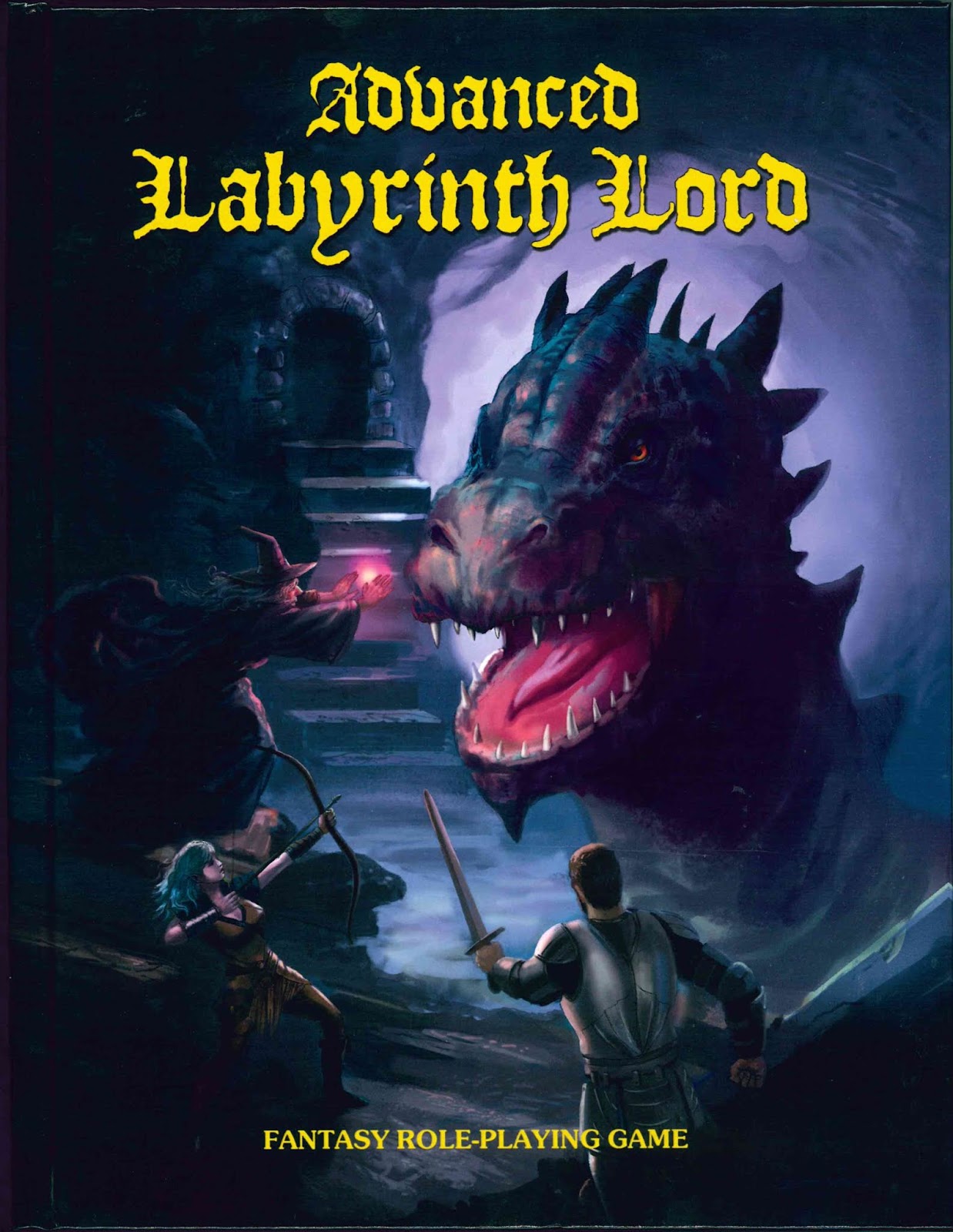
Labyrinth Lord itself exists in several printings with a variety of cover illustrations (and there is a free digital version as well). The latest iteration is titled Advanced Labyrinth Lord and combines the original Labyrinth Lord based on basic/expert with material from Mr. Proctor's Advanced Companion - a volume that adds in additional classes, spells and monsters similar to TSR's Advanced Game and provides for the separation of character "race" and class as found in the Advanced system. The image above shows one of two covers currently available as a print-on-demand hardcover of the Advanced Labyrinth Lord.
The OSR is a creative and hard working group and they have produced a number of system variations using the B/X model as a basis. Notable mentions in this category from my personal collection include Lamentations of the Flame Princess, Basic Fantasy and most recently B/X Essentials.
Lamentations... is an awesome adaptation of the B/X core heavily impregnated with the character of its creator, James E. Raggi IV (word choice is deliberate and if you are familiar with LotFP you know why). Mr. Raggi subtitles his work as "Weird Fantasy Role-Playing" and anyone familiar with the books will understand why. Lamentations... may not be to everyone's liking, but the changes Mr. Raggi makes to the standard B/X rules produces an unmistakable tone and includes many good ideas ( such as encumbrance and specialist skills).
Basic Fantasy is a Chris Gonnerman game based on the B/X model while incorporating many newer conveniences. BF is incredibly playable and one of the better introductory RPG systems with years of play-ability. It has the added advantage of being priced so as to be about as good a bargain as one could ever hope for. Mr. Gonnerman has supported Basic Fantasy with a library of well written supplements and play aids. There is literally no reason that a copy of Basic Fantasy should not be in every FRPG hobbyist's collection.
B/X Essentials is a print on demand product by Necrotic Gnome. Essentials reorganizes the cloned B/X system material into several volumes, each of which is the small digest size used by the White Box. Volumes include the Core Rules, Classes and Equipment, Cleric and Magic User Spells, Monsters and, Adventures and Treasures. The modular organization allows for a seamless combing of levels 1-3 and 4-14 from the Basic and Expert Rules respectively and for the substitution of any new module such as replacing the Classes and Equipment book with one more directly aimed at your campaign. In many ways, the B/X Essentials: Core Rules is closest to the original Moldvay/Cook/Marsh game and also the most adaptable (B/X Essentials: Demihumans of Dolmenwood is an add-on for the Dolmenwood mini-setting). For do-it-yourself enthusiasts or those seeking a well organized B/X feel, Essentials is also a good choice.
The continued popularity of the B/X system despite its being out-of-print leads to one of the first retro-clones to appear as part of the "old school renaissance" or OSR movement. Labyrinth Lord by Daniel Proctor uses the System Reference Document under the Open Game License to create a game system very close to the original Basic/Expert Rules thereby allowing authors in the OSR to publish new material which is fully compatible with both Labyrinth Lord and therefore the originals. Part of the beauty of the original editions of both the Basic and Advanced Games is a cross compatibility allowing the hobbyist to use play aids written for one version of the system with all the other versions. This remains true until the 3rd edition (and later) published by Wizbros.
Labyrinth Lord itself exists in several printings with a variety of cover illustrations (and there is a free digital version as well). The latest iteration is titled Advanced Labyrinth Lord and combines the original Labyrinth Lord based on basic/expert with material from Mr. Proctor's Advanced Companion - a volume that adds in additional classes, spells and monsters similar to TSR's Advanced Game and provides for the separation of character "race" and class as found in the Advanced system. The image above shows one of two covers currently available as a print-on-demand hardcover of the Advanced Labyrinth Lord.
The OSR is a creative and hard working group and they have produced a number of system variations using the B/X model as a basis. Notable mentions in this category from my personal collection include Lamentations of the Flame Princess, Basic Fantasy and most recently B/X Essentials.
Basic Fantasy is a Chris Gonnerman game based on the B/X model while incorporating many newer conveniences. BF is incredibly playable and one of the better introductory RPG systems with years of play-ability. It has the added advantage of being priced so as to be about as good a bargain as one could ever hope for. Mr. Gonnerman has supported Basic Fantasy with a library of well written supplements and play aids. There is literally no reason that a copy of Basic Fantasy should not be in every FRPG hobbyist's collection.
B/X Essentials is a print on demand product by Necrotic Gnome. Essentials reorganizes the cloned B/X system material into several volumes, each of which is the small digest size used by the White Box. Volumes include the Core Rules, Classes and Equipment, Cleric and Magic User Spells, Monsters and, Adventures and Treasures. The modular organization allows for a seamless combing of levels 1-3 and 4-14 from the Basic and Expert Rules respectively and for the substitution of any new module such as replacing the Classes and Equipment book with one more directly aimed at your campaign. In many ways, the B/X Essentials: Core Rules is closest to the original Moldvay/Cook/Marsh game and also the most adaptable (B/X Essentials: Demihumans of Dolmenwood is an add-on for the Dolmenwood mini-setting). For do-it-yourself enthusiasts or those seeking a well organized B/X feel, Essentials is also a good choice.
Wednesday, February 13, 2019
Greyhawk Paladin
The First Sub-Class
Supplement I, Greyhawk introduces a new character class, Thieves (on the "dark side" of alignment) and a new sub-class of Fighting Men, the Paladin - paragon of virtue. According to Supplement I, fighting men with Charisma scores of 17 or greater may gain paladin status "...IF THEY ARE LAWFUL from the commencement of play..." The paladin is a unique character, both trusted and well liked, with a knack for leadership and inspiring loyalty, all as evidenced by the superior charisma score, and perhaps more to the original point, the Paladin is a totally lawful acting hero. Paladin status bestows upon the character the following abilities; to heal wounds and disease by "laying on hands", to detect the presence of evil, a bonus to saving throws, and the ability to dispel evil once they become a superhero. If in possession of any "Holy Sword" the paladin becomes immune to the effects of magic attack.
With the ability to heal wounds and disease and confront evil, the paladin is frequently compared to a cleric of lawful alignment. I see the character classes as quite different, however. The concept of the cleric is one devoted to religion, be it a pantheon, a specific deity or merely the cleric's alignment. Upon reaching name level the cleric may build a temple and gather followers. Clerics are holy warriors with the ability to cast a number of different spells (miracles) granted by their faith. They also have power over the undead monsters. The inspiration for the cleric class is perhaps the religious orders of knighthood. At least that is what I think.
Paladins are fighting men who serve a lawful cause. The original paladins of legend served Charlemagne who himself served God. This origin is an important distinction. The paladin serves the social order, established ruler(s) and the "might for right" cause (see the paladin in Poul Anderson's Three Hearts and Three Lions). With high charisma they are inspiring to others. They give hope to those downtrodden by their mere presence (as in Elizabeth Moon's Deed of Parksenarrion, another excellent paladin story).
According to Supplement I, the paladin will normally prefer to dwell with a lawful prince and will gift most of their earned wealth to the poor and to religious institutions. The paladin will only retain four magical items, excluding armor and shield and up to four magical weapons. "They will give away all treasure they win, save that which is necessary to maintain themselves, their men, and a modest castle." It is as if they have a vow of poverty. Obviously their motive for action is different from the usual adventurer who is out for gold.
Paladins have gained a reputation due to the way many have been played over the decades, but I do not believe the intent is for them to be the moral police. They are champions devoted to the defense of human society at its best. They embody many of the ideals of chivalry and are prohibited from committing dastardly deeds or associating with those who do. It seems simple to play the paladin as a champion of order and a self sacrificing servant of a noble cause, rather than as a self righteous bully. Of course settings vary and in your world paladins may be something totally different than in Greyhawk or in my world.
The distinction between cleric and paladin may seem trivial, but I see it as similar to the difference between a knight Templar and the paladins of Charlemagne or the Knights of the Round Table.
Supplement I, Greyhawk introduces a new character class, Thieves (on the "dark side" of alignment) and a new sub-class of Fighting Men, the Paladin - paragon of virtue. According to Supplement I, fighting men with Charisma scores of 17 or greater may gain paladin status "...IF THEY ARE LAWFUL from the commencement of play..." The paladin is a unique character, both trusted and well liked, with a knack for leadership and inspiring loyalty, all as evidenced by the superior charisma score, and perhaps more to the original point, the Paladin is a totally lawful acting hero. Paladin status bestows upon the character the following abilities; to heal wounds and disease by "laying on hands", to detect the presence of evil, a bonus to saving throws, and the ability to dispel evil once they become a superhero. If in possession of any "Holy Sword" the paladin becomes immune to the effects of magic attack.
With the ability to heal wounds and disease and confront evil, the paladin is frequently compared to a cleric of lawful alignment. I see the character classes as quite different, however. The concept of the cleric is one devoted to religion, be it a pantheon, a specific deity or merely the cleric's alignment. Upon reaching name level the cleric may build a temple and gather followers. Clerics are holy warriors with the ability to cast a number of different spells (miracles) granted by their faith. They also have power over the undead monsters. The inspiration for the cleric class is perhaps the religious orders of knighthood. At least that is what I think.
Paladins are fighting men who serve a lawful cause. The original paladins of legend served Charlemagne who himself served God. This origin is an important distinction. The paladin serves the social order, established ruler(s) and the "might for right" cause (see the paladin in Poul Anderson's Three Hearts and Three Lions). With high charisma they are inspiring to others. They give hope to those downtrodden by their mere presence (as in Elizabeth Moon's Deed of Parksenarrion, another excellent paladin story).
According to Supplement I, the paladin will normally prefer to dwell with a lawful prince and will gift most of their earned wealth to the poor and to religious institutions. The paladin will only retain four magical items, excluding armor and shield and up to four magical weapons. "They will give away all treasure they win, save that which is necessary to maintain themselves, their men, and a modest castle." It is as if they have a vow of poverty. Obviously their motive for action is different from the usual adventurer who is out for gold.
Paladins have gained a reputation due to the way many have been played over the decades, but I do not believe the intent is for them to be the moral police. They are champions devoted to the defense of human society at its best. They embody many of the ideals of chivalry and are prohibited from committing dastardly deeds or associating with those who do. It seems simple to play the paladin as a champion of order and a self sacrificing servant of a noble cause, rather than as a self righteous bully. Of course settings vary and in your world paladins may be something totally different than in Greyhawk or in my world.
The distinction between cleric and paladin may seem trivial, but I see it as similar to the difference between a knight Templar and the paladins of Charlemagne or the Knights of the Round Table.
Subscribe to:
Posts (Atom)