Thursday, February 14, 2019

Cloning B/X

The Basic Rules as edited by Tom Moldvay is legendary across the hobby as one of the cornerstone and premier versions of the World's Most Popular Role-Playing Game. Many gamers have come to the hobby through the "Moldvay Basic" rules, which remains the preferred dungeon delving rule system for many. Frequently referred to as B/X (the second volume in the series is the Expert Rules edited by David "Zeb" Cook with Steve Marsh), the Tom Moldvay Basic Rules remains one of the most popular interpretations of role-play rules and is still in popular demand 38 years after its introduction. The Basic Rules, published by TSR includes rules for character levels 1 to 3 and requires the Expert Rules to advance character beyond 3rd level. The B/X system supports human characters with the Fighter, Cleric, Magic User and Thief class. The demi-humans (dwarves, elves and halflings) each have their own class.
The continued popularity of the B/X system despite its being out-of-print leads to one of the first retro-clones to appear as part of the "old school renaissance" or OSR movement. Labyrinth Lord by Daniel Proctor uses the System Reference Document under the Open Game License to create a game system very close to the original Basic/Expert Rules thereby allowing authors in the OSR to publish new material which is fully compatible with both Labyrinth Lord and therefore the originals. Part of the beauty of the original editions of both the Basic and Advanced Games is a cross compatibility allowing the hobbyist to use play aids written for one version of the system with all the other versions. This remains true until the 3rd edition (and later) published by Wizbros.
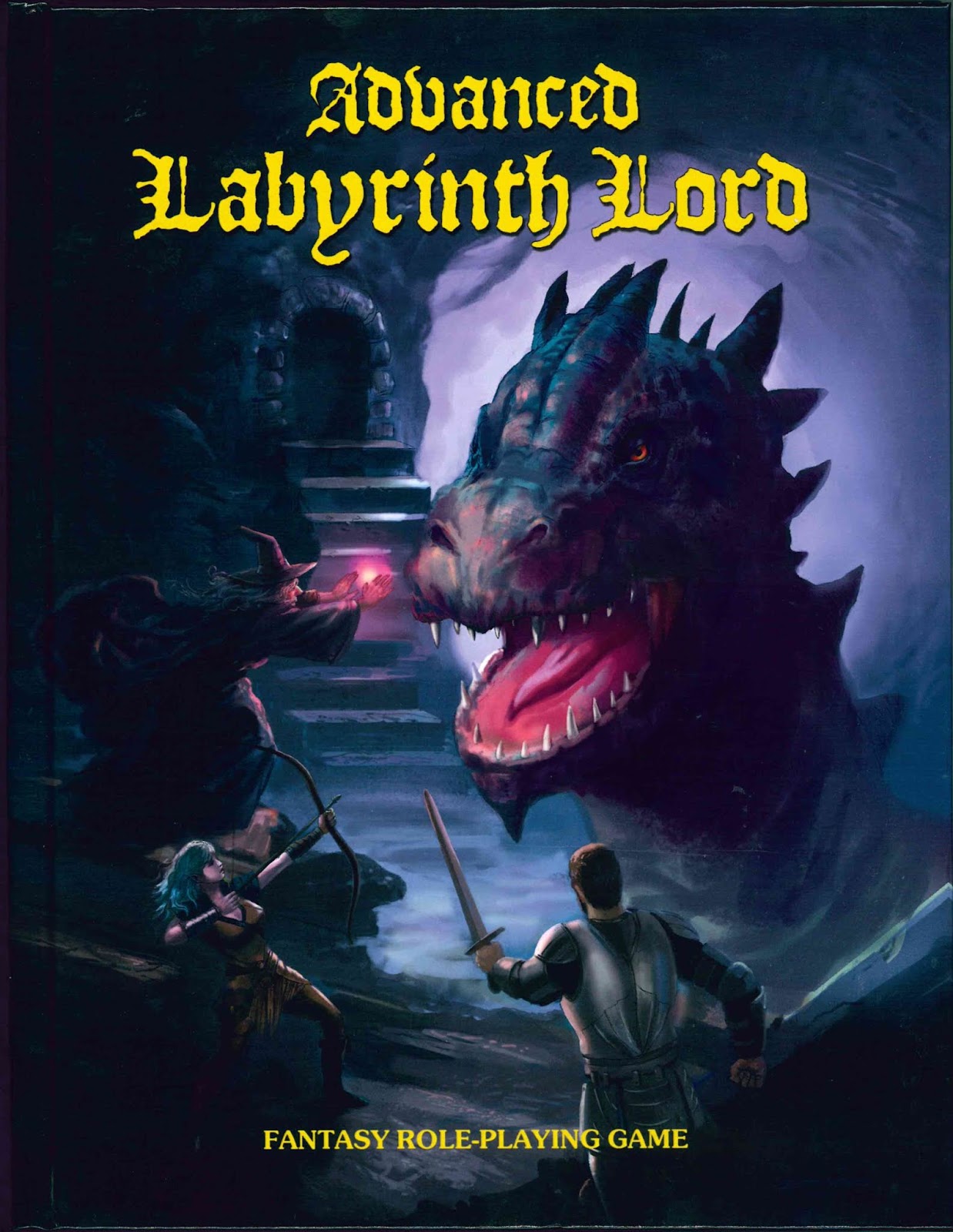
Labyrinth Lord itself exists in several printings with a variety of cover illustrations (and there is a free digital version as well). The latest iteration is titled Advanced Labyrinth Lord and combines the original Labyrinth Lord based on basic/expert with material from Mr. Proctor's Advanced Companion - a volume that adds in additional classes, spells and monsters similar to TSR's Advanced Game and provides for the separation of character "race" and class as found in the Advanced system. The image above shows one of two covers currently available as a print-on-demand hardcover of the Advanced Labyrinth Lord.
The OSR is a creative and hard working group and they have produced a number of system variations using the B/X model as a basis. Notable mentions in this category from my personal collection include Lamentations of the Flame Princess, Basic Fantasy and most recently B/X Essentials.
Lamentations... is an awesome adaptation of the B/X core heavily impregnated with the character of its creator, James E. Raggi IV (word choice is deliberate and if you are familiar with LotFP you know why). Mr. Raggi subtitles his work as "Weird Fantasy Role-Playing" and anyone familiar with the books will understand why. Lamentations... may not be to everyone's liking, but the changes Mr. Raggi makes to the standard B/X rules produces an unmistakable tone and includes many good ideas ( such as encumbrance and specialist skills).
Basic Fantasy is a Chris Gonnerman game based on the B/X model while incorporating many newer conveniences. BF is incredibly playable and one of the better introductory RPG systems with years of play-ability. It has the added advantage of being priced so as to be about as good a bargain as one could ever hope for. Mr. Gonnerman has supported Basic Fantasy with a library of well written supplements and play aids. There is literally no reason that a copy of Basic Fantasy should not be in every FRPG hobbyist's collection.
B/X Essentials is a print on demand product by Necrotic Gnome. Essentials reorganizes the cloned B/X system material into several volumes, each of which is the small digest size used by the White Box. Volumes include the Core Rules, Classes and Equipment, Cleric and Magic User Spells, Monsters and, Adventures and Treasures. The modular organization allows for a seamless combing of levels 1-3 and 4-14 from the Basic and Expert Rules respectively and for the substitution of any new module such as replacing the Classes and Equipment book with one more directly aimed at your campaign. In many ways, the B/X Essentials: Core Rules is closest to the original Moldvay/Cook/Marsh game and also the most adaptable (B/X Essentials: Demihumans of Dolmenwood is an add-on for the Dolmenwood mini-setting). For do-it-yourself enthusiasts or those seeking a well organized B/X feel, Essentials is also a good choice.

Wednesday, February 13, 2019

Greyhawk Paladin

The First Sub-Class
Supplement I, Greyhawk introduces a new character class, Thieves (on the "dark side" of alignment) and a new sub-class of Fighting Men, the Paladin - paragon of virtue. According to Supplement I, fighting men with Charisma scores of 17 or greater may gain paladin status "...IF THEY ARE LAWFUL from the commencement of play..." The paladin is a unique character, both trusted and well liked, with a knack for leadership and inspiring loyalty, all as evidenced by the superior charisma score, and perhaps more to the original point, the Paladin is a totally lawful acting hero. Paladin status bestows upon the character the following abilities; to heal wounds and disease by "laying on hands", to detect the presence of evil, a bonus to saving throws, and the ability to dispel evil once they become a superhero. If in possession of any "Holy Sword" the paladin becomes immune to the effects of magic attack.
With the ability to heal wounds and disease and confront evil, the paladin is frequently compared to a cleric of lawful alignment. I see the character classes as quite different, however. The concept of the cleric is one devoted to religion, be it a pantheon, a specific deity or merely the cleric's alignment. Upon reaching name level the cleric may build a temple and gather followers. Clerics are holy warriors with the ability to cast a number of different spells (miracles) granted by their faith. They also have power over the undead monsters. The inspiration for the cleric class is perhaps the religious orders of knighthood. At least that is what I think.
Paladins are fighting men who serve a lawful cause. The original paladins of legend served Charlemagne who himself served God. This origin is an important distinction. The paladin serves the social order, established ruler(s) and the "might for right" cause (see the paladin in Poul Anderson's Three Hearts and Three Lions). With high charisma they are inspiring to others. They give hope to those downtrodden by their mere presence (as in Elizabeth Moon's Deed of Parksenarrion, another excellent paladin story).
According to Supplement I, the paladin will normally prefer to dwell with a lawful prince and will gift most of their earned wealth to the poor and to religious institutions. The paladin will only retain four magical items, excluding armor and shield and up to four magical weapons. "They will give away all treasure they win, save that which is necessary to maintain themselves, their men, and a modest castle." It is as if they have a vow of poverty. Obviously their motive for action is different from the usual adventurer who is out for gold.
Paladins have gained a reputation due to the way many have been played over the decades, but I do not believe the intent is for them to be the moral police. They are champions devoted to the defense of human society at its best. They embody many of the ideals of chivalry and are prohibited from committing dastardly deeds or associating with those who do. It seems simple to play the paladin as a champion of order and a self sacrificing servant of a noble cause, rather than as a self righteous bully. Of course settings vary and in your world paladins may be something totally different than in Greyhawk or in my world.
The distinction between cleric and paladin may seem trivial, but I see it as similar to the difference between a knight Templar and the paladins of Charlemagne or the Knights of the Round Table.

Tuesday, February 12, 2019

Revisiting Greyhawk

Swords & Sorcery Adventure
In his Foreword to Supplement I, Greyhawk, Gary Gygax refers to "...the swords and sorcery of DUNGEONS & DRAGONS games." The fantastical fiction stories written by pulp magazine and science fiction authors and generally termed "swords and sorcery" served as an inspiration for the authors and players of the World's Original Fantasy RPG. Emulating the swords and sorcery style adventure story was seen as a goal of the early game, which combined with a new gaming phenomenon growing in popularity, specifically the underground dungeon, and an increasing audience for fantasy, in part due to the work of J.R.R. Tolkien, resulted in a large market for the new hobby which surprised even the creators. To feed the desire for the public to know more about this new wonder, TSR published additional material in the form of more Little Brown Books they titled "Supplements". The first two supplements are titled after the home campaigns of the two original authors, Greyhawk and Blackmoor.
Supplement I sets the standard for future additions to the popular system of TSR Rules. Included are additional classes, new spells and more monsters, magical treasures, "...and various additions to the suggestions and rules for adventuring above and below the ground." Future supplements to the Original Game and later versions published by TSR will follow the format set forth in Greyhawk. The organization of Supplement I mimics that of the original three Little Brown Books with sections devoted to Men & Magic, Monsters & Treasure and The Underworld & Wilderness Adventures. It is the additions under Men & Magic that signal a major alteration to the Original Rules. Supplement I adds a fourth character class, Thieves, to the milieu. Thieves may be neutral or chaotic in alignment, but not lawful, "...although lawful characters my hire them on a one-time basis for missions which are basically lawful."
Thieves progress in certain basic abilities including opening locks, listening for noise behind closed doors, hide in shadows, move with great stealth, and strike silently from behind. The abilities improve with level advancement. Hear Noise is listed as starting at a 2 in 6 chance, the ability to Open Locks and Remove Traps starts at a modest 15% and 10% respectively. The scores needed to Pick Pockets or Move Silently is 20%, and Hide In Shadows is 10% at level 1. Striking silently from behind grants the Thief a 20% (+4) bonus to hit and inflicts double damage. Thieves can also climb nearly shear surfaces, but Supplement I does not offer a numerical value for this ability, rather stating at level 1 there is a 13% chance of falling while climbing.
I find the Thief class troublesome on two levels. 1) The ability scores needed to succeed are so poor at 1st level (except Listening for Noise?) as to suggest nothing but failure most of the time, failure leading to discovery and conflict;  2) The use of a percentage mechanic seems inconsistent with the d6 and d20 dice used to determine outcome in other abilities, and;   3) By the inclusion of Thieves, Supplement I seems to imply that these abilities are unique to Thieves and therefore unavailable to non-thieves. No moving silently for Magic Users. No striking from behind advantage for Fighting Men. How about listening for noise at closed doors?
Non-human characters, elves, dwarves and hobbits (halflings), all have class restrictions and level limits in the White Box. presumably to encourage players to choose human characters. Thieves have no level limits for dwarves, elves, half-elves (a new race introduced in Greyhawk) or hobbits who all may continue "...to advance to the highest levels." Inclusion of half-elves as a player character race option expands the scope of the milieu in an interesting way. In Vol. 1, Men & Magic it states under the heading Other Character Types: "There is no reason that players cannot be allowed to play as virtually anything, provided they begin relatively weak and work up to the top". Whether inspired by certain characters found in Professor Tolkien's work, or based on some other source in the Greyhawk campaign, half-elves are described in Supplement I as a mix of elvish and human heritage and may advance as Magic Users and Fighting Men similar to the rules for elves and may be Thieves per Supplement I. The book states, "There are no half-elf Clerics, for in this regard their human side prevails." However, it also states "...half-elves with a basic wisdom score of 13 or more may also become clerics.
Some "fixes" or houserules that can make Greyhawk Thieves more appealing to me include placing level limits on the class for demihumans consistent with White Box. The low starting percentages for Thieves can be mitigated by the referee treating Thieves abilities rather like Keepers often treat skills in Call of Cthulhu, that is assign a "bonus" to easy traps, locks, etc. thereby making it more likely Thieves will succeed. Thieves are not a bad idea, but I do think they belong in certain campaigns and not so much others. If the referee fancies a lot of urban intrigue and sculduggery, by all means include Thieves. Perhaps even encourage most players to pick the class for their PC. Thieves may make an appearance in campaigns centered upon dungeon delving, but I personally would leave them out. Thieves and paladins (a new sub-class of fighting men introduced in Greyhawk) don't work in the same party because - Alignment! Supplement I states, "They [paladins] will associate only with lawful characters."
It seems that the half-elves require some explanation as well. I rather like the approach taken in the Midgard Worldbook by Kobold Press which portrays half-elves as being folks with some elvish blood. They are termed the elfmarked and they may manifest certain elvish traits. I have borrowed this idea for my own home-brew campaign where a 30+ year war between the elves and men has resulted in the true elves withdrawing from the world leaving only a scattering of humans with elvish blood (half-elves) behind.

"...it appears that there will never be an end to the development of fresh ideas..." - E. Gary Gygax, Supplement I, Greyhawk, 1975

Friday, February 8, 2019

Print on Demand

What a Boon!
Today we have digital images of game product, both old and new, which can be affordably printed and bound to create physical books through print on demand services. While I do make use of digital images on various electronic devices, my preferred media remains the physical book. I like to hold a book, flip through the pages and even smell the paper and ink. I am "old school". I even prefer to get my daily news by reading a printed newspaper...and get my hands dirty with ink. It seems suiting given what I frequently read in the news.
There are many titles available as print on demand that would otherwise not be available to the small number of consumers who would purchase them. The volume of sales does not warrant a large commercial print run and marketing. The Glorantha setting reference volumes written by world creator Greg Stafford are interesting to me as a devotee of the Glorantha setting and I appreciate their being available as print on demand softcover books. For the uninitiated, the Heortling people are the inhabitants of Dragon Pass who worship the storm pantheon including Ernalda the earth goddess and Orlanth the storm god. The Stafford Library series does for Glorantha something similar to what The Silmarillion does for Middle Earth.
Out of print since 1978, the first edition of RuneQuest is also a print on demand product available through Chaosium and Lulu Publishing. This is the first role-playing game to use the Glorantha setting discovered and revealed by Greg Stafford. RuneQuest introduces a novel roll under d100 skill based system that by-passes character class and allows all player characters access to magic. The d100 system developed by Steve Perrin & Friends for The Chaosium serves as the basis of many later games published by Chaosium and has come to be known as the Basic Role-Playing system. Print on demand service has brought many of the older role-playing publications into availability again at prices much lower than those found in the secondary market. They are generally printed from digital scans of the original so the content is the same as the original, but there can be occasional scanning issues (which are often corrected once reported).
The combination of availability and price makes print on demand a nice option for the niche consumer and there are many titles available through this service that are not available in any other physical format. I have become a fan of print on demand.

Thursday, February 7, 2019

Chivalry & Sorcery 3rd Edition

Role-Play in a Feudal Way
Chivalry & Sorcery 3e is G.W. Thompson's take on the work of Edward Simbalist and Wilf Backhaus, the original authors of C&S. It is interesting that Mr. Simbalist and Mr. Backhaus dedicate this 3rd edition to the Society for Creative Anachronism (S.C.A.) - a medieval society reenactment group. The S.C.A. educates its members about the feudal system practiced in Europe during the middle ages and its popular re-interpretation in literature including the King Arthur legends. The Society holds events where members dress in period costume and assume the manners and customs they associate with chivalry and feudal society. I believe that spirit is also present in C&S as a role-playing game.
To appreciate C&S one must have some interest in medieval feudalism. The game, in all its editions, encourages role-play in a shared fictional society where the norm of play includes expected modes of behavior based on the code of chivalry, deference to those PCs and NPCs with higher social standing and an interest in the day-to-day lives of your imaginary characters. The reward is (according to the authors) an immersive experience only possible when role-playing in a believable setting.
The 3rd Edition introduces the central mechanic concept to the C&S rules using what the authors call the Skillscape system. Basically it is a skill based mechanic using a d100 roll under test for success and a third d10, called a Crit Die, used to determine the quality of success or failure (thus rolling 3 d10). Each skill in the game has a success and failure table on which is described the Crit Die effect. Success on the wine making skill may result in an average vintage to a truly great vintage depending on the value rolled on the Crit Die. Failure in the wine making skill roll can vary results from disastrous to below average wine.
C&S 3e remains a class based system. The character classes, referred to as Vocations, include Warriors, Thieves, Clergy and Mages with sub-classes of each. Skills, including those used in combat, are based on the Vocation (the word "class" refers to the social hierarchy in C&S). The Mage Vocations includes the Druid, Witchcraft, Enchanters, Magicians (Generalists), Necromancers, Power Word Mages and Thaumaturges.
The authors say that the C&S 3e core rulebook is all that is needed to play the game. It is supported by the recommended Game Master's Handbook which includes information on how to create a fantasy setting, design monsters for the system, and advice on how to run a feudal campaign using the C&S game. A very brief bestiary is included at the end of the core rules, but the supplemental C&S Creatures Bestiary volume contains many more. Supporting volumes on Knighthood and Sorcery are listed in the back of the core book and may appeal to some seeking additional system material.
Published in 1996, C&S 3e attempts to bring feudal role-playing to a more modern audience by offering a universal mechanic, the Skillscape system, an updated layout, new artwork, and a single volume presentation of the core rules. The updates are aimed at producing a game system where mechanics take a back seat to role-play, but the need to continually consult the rule book for the critical tables associated with every skill seems to be at odds with this goal. The rules to C&S have always been about perceived "realism" and produce a somewhat slow system, although one with a lot of period feel and flavor.

Wednesday, February 6, 2019

Role-Play Can Ruin The Game

...when it hinders the shared fun.
What started out as "Rules for Fantastic Medieval Wargames Campaigns Playable with Paper and Pencil and Miniature Figures" and was quickly referred to as an "adventure game" eventually became known as the first "role-playing" game. The hobby of role-playing quickly gained popularity and at least by the mid 1980s folks were referring to the collective hobby as "role-playing" (with or without the hyphen). Many rule systems start their explanation of the rules of play by defining role-play as something like putting yourself into the role of your adventurer or player character. Some compare it to acting a part as in a radio drama. "Good" role-playing for some groups may consist of staying "in character" during the game. The goal is to not play yourself, but to make game decisions by thinking what would my character do?
The effort to stay "in character" and make decisions at the table based on what you think your character would do can be problematic. It can get in the way of the group having fun and can even cause arguments and hurt feelings. When staying "in character" leads to an evilly aligned PC doing something objectionable or even harmful to the party of adventurers, thereby adversely affecting everyone else's fun, it is poor sportsmanship to claim, "It's what my character would do!" Playing a character is not an excuse to behave poorly, even if the character is not a nice person. Such behavior violates the implied social contract that everyone at the table is there to have fun. The game is based on mutual cooperation, shared entertainment and courtesy to other players. This must come first, for without a commitment to these principles there can be no fun.
Less obvious is the conflicts which arise over different character motivations. Each role-player will tend to pursue the motives of their character during the game which may run contrary to the motives of other characters in the group. The key word is "group". This hobby involves playing a cooperative game that requires groups to work together to succeed and enjoy the shared fun.
It is therefore a good idea to take the whole playing a role concept in perspective. The role-play may need to stop at some point for the people playing the game to discuss going forward and what makes sense in terms of the shared fun. The characters are imaginary constructs that serve a purpose only so long as the game is enjoyable. The characters are not real people and we all need to keep that in perspective. If we drop the role-play in order to advance the game along mutually agreeable lines we succeed, if not and the game is ruined, we fail. Playing the game in a manner that benefits the players, not just their character(s), is an important consideration.

Tuesday, February 5, 2019

Chivalry & Sorcery 2e

Realistic Medieval Role-Play
The second edition of Chivalry & Sorcery comes as a box set. It divides the rules into three staple bound books (and increases the font size slightly). The second edition retains much of the spirit and feel of C&S 1e and is presented in a somewhat more user friendly format. The focus remains on role-playing in a realistic interpretation of a medieval feudal society with an emphasis on knighthood and chivalry. The fantasy elements (elves, dwarves and haeflings/hobbits) rely heavily on Tolkien for inspiration. Magick draws primarily from several historic traditions, such as alchemy, astrology, necromancy and witchcraft. Mythological beasts, including centaurs, minotaurs and harpies, are included to add a fantastical element to play. Role-play is defined as taking place inside a fictional society with rules and consequences and what one does between adventures is almost as import as the adventuring itself. One may play a thief or brigand in C&S, but should expect to be pursued by the forces of law and order.
The first book is devoted to character generation. It starts with game master advice regarding the implied setting parameters which are based on feudalism. It goes on to inform the player just what all makes role-playing in a setting based on feudalism different from that of our own society. Freedom and independence are quite lacking in feudal society and how one addresses their social superiors is very important. Character creation rules can be largely random and rolling on the tables can result in the character starting out as a serf or an escaped slave, or a prince of the realm. How such disparate personalities would end up adventuring together in a feudal setting poses some challenges. The C&S philosophy is don't expect equality (that is a modern American value). Of course the game master could just start all the characters with the same social birth rank. C&S is an old school game and the authors state clearly that game masters can alter the rules. C&S aspires to create a certain type of milieu, one quite different from what is found in many other FRPGs. C&S seeks to create a realistic feeling milieu where the character is living out their imaginary "life" in believable circumstances consistent with our knowledge of feudalism.
The second volume starts off with a discussion of chivalry including its progression over the centuries and its practicality as a way of life. Role-playing a character under The Chivalric Code requires attention to one's personal honor, one's word, obligations and alliances. Vol. 2 continues with a detailed discussion of the Chivalry & Sorcery Marketplace and shows how that can be based on a realistic assessment of medieval economies. A discussion of the Cleric as a player character, the medieval church and clergy, tournaments and jousting follows. The section on Individual Combat takes us to the end of Vol. 2. The C&S combat rules are somewhat complex and allow for the use of tactics as well as arms and armor all based on examples from the European middle ages. The knightly class has distinct martial advantages in C&S, which makes it fun to play a knight.
The third volume covers Magick & Magicians of all varieties. Like C&S 1e, 2e relies heavily on historical traditions of the supernatural powers (magic/magick) for inspiration. Magick practitioners may rely on their natural ability as Primitive Talent Magicians or seek schooling and practice magick as a form of sage knowledge. Elves and hedge wizards rely on primitive magick whereas scholarly magicians may study Drug Trance Magick, the Minor and Major Arcana, Alchemy, Astrology, Divination, Witchcraft, Conjuration, Enchantment, Necromancy, Thaumaturgy, Power Word Magick and Magick Square Mysticism (among others). The many spell descriptions are often very brief and much is left open for the referee/Game Master and players to determine regarding how magick effects play in C&S. Vol. 3 concludes with 35 pages of bestiary including demon profiles, beasts, NPCs (dastardly knights, infamous brigands, evil priests, wicked witches and villainous magicians), monsters (mostly mythological) and the undead.
The C&S 2e line of products includes the revised Sourcebook and Sourcebook 2, which are both based on the 1e equivalents. Sourcebook includes several articles, many written by C&S co-author Edward Simbalist, which I find an entertaining read. Articles included cover outdoors adventure, weather, monster design and the Forester class. As is usual in C&S this material relies heavily on the real world and a knowledge of history, which seems to be Mr. Simbalist's strong suit. Even in drawing upon fantastic influences, Mr. Simbalist refers frequently to various sources including the work of J.R.R. Tolkien, R.E. Howard, Michael Moorcock and Fritz Leiber. His discussion of the nature of monster mentality is quite thought provoking even today, suggesting monsters be designed and run in a logical, believable manner by the referee who should rely on knowledge of how intelligent beings and animals behave, what they eat and how most of them operate under a self preservation motive. Mr. Simbalist's article on feudal economics again rests firmly on research and this type of research, rather than the active imagination which fueled much of Mr. Gygax and Mr. Arneson's content, appears to form the basis of his game writing. The C&S 2e Sourcebook concludes with a new battle system for tabletop ancient and medieval miniatures games. The author mentions that he is a miniature wargamer (much like Gary Gygax and Dave Arneson) and he provides for us his Battle System for those who also enjoy battle games using large numbers of painted miniature figures.
While I greatly enjoy the content found in Sourcebook, some of that found in C&S Sourcebook 2 I find less inspiring. As the color illustration by Robert Charrette suggests, Sourcebook 2 contains an extensive discussion of doors, locks and breaking in. Mr. Simbalaist seems to be making a point here about realism and for my taste, there are more charts, values and mechanics describing how to adjudicate bashing down doors and picking locks than I care to use while at the table. Reading the articles does inform the referee/ gamemaster, in perhaps a useful way, regarding the reality of such common elements of a fantasy medieval roleplay adventure game and this knowledge can be used generally sans the specific C&S mechanics, which are optional as the author states. In fact, C&S is entirely presented in a very old school manner deferring to the gamemaster as having the ability to alter rules and procedures as well as create new content for their world.
The random table is a staple of old school games and Sourcebook 2 contains many. An article on how to determine what spells a non-player magician knows includes a number of them. Weaponsmithing, alchemical materials and magical items are the subject of their own articles and here I find some interesting and usable content, although much of it pertains to down-time between adventure. Sourcebook 2 also contains a couple useful articles on peasant revolts and how news and mail would be conveyed in a feudal society which can generate several ideas for adventure or can just form part of the background for PCs running a manor. Sourcebook 2 concludes with Phil McGregor's pen and paper strategic warfare system which allows for large-scale battle, siege and naval to be part of the campaign without the use of miniature figures.
I like C&S 2e almost as much as C&S 1e. C&S 2e is more accessible with its larger font (still small-ish by today's standards), better binding (Red Book tends to shed pages) and generally lower second hand prices. C&S has a very different "feel" to it when compared to White Box and most other FRPGs old and new. Red Book C&S talks about what the authors term "the Grand Campaign", which perhaps is an idea unique to C&S. The way I understand the Grand Campaign is that it sets out to immerse the players in a make-believe world through their imaginary characters who lead realistic lives from birth to death including a detailed down-time between adventures. The alliances and chivalric honor the PC amasses is at least as important as the fights and adventures one encounters during exploration of the imaginary world based on a feudal model. The fact that C&S provides very little mechanical reward for acting in character seems consistent with the design philosophy that this immersion in play is its own reward.
C&S is one of the "reaction RPGs" that were part of the zeitgeist of its 2nd generation era. It sets out to "fix" the problems the authors perceive to exist in other games (and states so quite clearly in several 1e passages). The details discussed and the general point of view expressed by the C&S authors are inspiring and I feel that in some ways I am more informed and equipped to referee and play all other games including White Box after a careful reading of C&S.