A Different Game
The Burning Wheel is an indie RPG that is a cut-above. The Gold Edition is its third and combines material that had previously been in two volumes, the Burning Wheel rules and the Character Burner. The Burning Wheel is a narrative game with a great deal of crunch and elements of a simulation style game. The mechanics are scale-able so that the referee can use quick simple resolutions or more detailed and lengthy systems to place emphasis on the conflict and outcome. The characters are very detailed with motivations and ethics that guide the player in role-playing them. The story is intended to be that which develops at the table, not one the referee has scripted ahead of time. It is an adventure game built to emphasize relationship and conflict and includes many new concepts. This game took me several reads in order to fully grasp it - it's that different from most other RPGs.
The Character Burner, or chargen system, is one of the more detailed chargen systems I have encountered. Players can choose to play a human, an elf, a dwarf or an orc in the Gold Edition. The Character Burner uses a life path system that generates the character's backstory and characteristics (skills & traits) from birth to the point where they start adventuring. Each race has a unique life paths to choose from. Instincts and Beliefs give the character motivation and something to fight for.
Conflict is at the center of The Burning Wheel and the referee is tasked with challenging each character's Beliefs in an effort to develop story and see the character grow and change as the game progresses. Characters frequently undergo significant changes in their goals and attitudes as a result of their conflicts. The Burning Wheel uses a dice pool system of six sided dice for testing various abilities, skills, and traits. Success leads to improvement, but so does challenging oneself with more difficult tests even though the attempt fails. Conflicts may involve combat, which can be handled one of three ways depending on the desired complexity level of the mechanics used, social conflict, chases, negotiation and spell casting.
The Burning Wheel introduces several new concepts and this can make the learning curve a bit steep. Rather than using money, the game makes use of a resource mechanic. If a character desires to by something, they may test their Resources to see if they are able to fund the purchase. Leveraging one's Resources can also lead to debt. Circles is another novel concept. Circles refers to the groups of people the player character has access to. One can test their Circles to discover information or acquire assistance in some endeavor. Circles and Resources are abilities which are developed through Life Paths and through adventuring.
The Burning Wheel does not include a specific default setting and their are a number of setting books that have been published for it ranging from a post apocalyptic setting to one based on ancient Japan. Because there is no default setting, there is no bestiary. The Burning Wheel PC races and life paths do imply a rather Tolkienesque setting, however. This works quite well in my experience as Middle Earth is the setting I have used The Burning Wheel for. The human Life Paths seem historical for the most part and I could easily see The Burning Wheel being used for a game set in a medieval European setting as well. The setting books will generally introduce their own unique Life Paths that reflect life in that setting.
This is not a dungeon delving sort of game. The Burning Wheel is about creating a story together as we play characters who test themselves and have their goals and attitudes changed by their experiences during the game. If dungeon Delving is desired, The Burning Wheel folks have a game, Torchbearer, specifically designed for that type of play. I consider it an excellent game and should probably give it its own post someday. This hobby offers so many great games it is hard to find the time for all of them!
Being the observations, recollections and occasional ramblings of a long-time tabletop gamer.
Thursday, May 4, 2017
Wednesday, May 3, 2017
White Box Magic
Magical Intent
In The Strategic Review, Vol.2, No. 2, Gary Gygax explains the Magic System and a little more regarding the design of the game in an article titled "The Dungeons & Dragons Magic System". In the opening paragraph he notes that the game was designed with the underworld adventure, the dungeon as the major factor in game play. He states wilderness adventure took a secondary role and tabletop battles, in which player characters took part, assumed a very minor role. This decision, to emphasize the dungeon experience, helped dictate how magic would work in the game.
Mr. Gygax describes the four basic types of magic as ritual, short spoken spells, ultra-powerful magic, and weak magic. He gives literary reference for each type of magic. The ritual type, involving lengthy conjuration and much paraphernalia, he ascribes to the works of R.E. Howard and Wm. Shakespear (Macbeth). The short spoken spell he credits to Finnish folklore tradition (Kalevala) and author Jack Vance (Vancian magic). The ultra-powerful magic he describes as typical of the Harold Shea stories of deCamp & Pratt. The weak and generally ineffective magic he associates with works by J.R.R. Tolkien.
Mr. Gygax indicates that his desire was for magic to be an integral part of the game and therefore the magic user should not be overshadowed by the fighting men. Magic could not be time consuming nor ineffective, so the ritual and weak and ineffective types were deemed unsuitable for the game. It was therefore decided to make magic effective and fairly powerful, when used effectively, and rather quick so that it was effective in combat. The so-called Vancian system seemed to balance potential power with a spoken spell that could be cast (thrown) quickly, yet remained scale-able.
Magic in the game is designed around four distinct components, the verbal or uttered, the somatic, or physical movement required, the mental aspect (mnemonics) and the material adjuncts. Much of this "theory" of magic can be related to the Harold Shea stories where the main characters discuss the nature of magic among themselves. Mr. Gygax expounds on this "theory" of magic as including the effects of altering substances, creating new material, changing certain aspects of mind or body, the addition of new functions to mind or body, the summoning and commanding of existing entities, and finally the creation of new entities. The "spells" were then created using this system of organization with both strong and weak examples of each so that spell levels might be used to balance the magic using classes with the non-magic users. Mr. Gygax notes that many spells were developed with dungeon delving and wilderness adventure in mind. A few, mostly those carried over from Chainmail, were included with tabletop battle in mind. According to Mr. Gygax all spells were designed so as to be spoken, most with a small somatic component, and many had a material component as well. These component descriptions would not appear until the Advanced game, but were assumed in White Box. All spells were mnemonic in that they had to be memorized and once cast were lost to memory requiring the consultation of spell books in order to be re-memorized.
The idea, according to Mr. Gygax, was for magic users to be balanced with all other character classes, but due to various factors including magic items usable by magic users only and various misunderstandings on the part of many players, perhaps due to the game itself not fully explaining the rules for magic, that often was not the case according to the author. He states the principle problem was one of not understanding the limits of single usage for memorized spells and scrolls. Once cast, those spells are unavailable until further preparation (consulting the spell books and re-memorizing the spell or inscribing a new scroll respectively) is undergone.
Mr. Gygax takes the opportunity afforded in the article to remind readers, especially referees, that magic should be balanced with regard to other character classes and the game should not be allowed to "degenerate' into a magic user show. He talks about progressing at a slow pace with regards to PC leveling and of limiting spells to 10th level. He mentions it was always the intent for players to take the game beyond the rules with regard to inventing new spells and magic, new character classes and new worlds, but cautions that at some point the game may cease to resemble to original intent of the author(s) - that being a game for relatively low-level dungeon and wilderness exploration and maybe some tabletop battle gaming.
In The Strategic Review, Vol.2, No. 2, Gary Gygax explains the Magic System and a little more regarding the design of the game in an article titled "The Dungeons & Dragons Magic System". In the opening paragraph he notes that the game was designed with the underworld adventure, the dungeon as the major factor in game play. He states wilderness adventure took a secondary role and tabletop battles, in which player characters took part, assumed a very minor role. This decision, to emphasize the dungeon experience, helped dictate how magic would work in the game.
Mr. Gygax describes the four basic types of magic as ritual, short spoken spells, ultra-powerful magic, and weak magic. He gives literary reference for each type of magic. The ritual type, involving lengthy conjuration and much paraphernalia, he ascribes to the works of R.E. Howard and Wm. Shakespear (Macbeth). The short spoken spell he credits to Finnish folklore tradition (Kalevala) and author Jack Vance (Vancian magic). The ultra-powerful magic he describes as typical of the Harold Shea stories of deCamp & Pratt. The weak and generally ineffective magic he associates with works by J.R.R. Tolkien.
Mr. Gygax indicates that his desire was for magic to be an integral part of the game and therefore the magic user should not be overshadowed by the fighting men. Magic could not be time consuming nor ineffective, so the ritual and weak and ineffective types were deemed unsuitable for the game. It was therefore decided to make magic effective and fairly powerful, when used effectively, and rather quick so that it was effective in combat. The so-called Vancian system seemed to balance potential power with a spoken spell that could be cast (thrown) quickly, yet remained scale-able.
Magic in the game is designed around four distinct components, the verbal or uttered, the somatic, or physical movement required, the mental aspect (mnemonics) and the material adjuncts. Much of this "theory" of magic can be related to the Harold Shea stories where the main characters discuss the nature of magic among themselves. Mr. Gygax expounds on this "theory" of magic as including the effects of altering substances, creating new material, changing certain aspects of mind or body, the addition of new functions to mind or body, the summoning and commanding of existing entities, and finally the creation of new entities. The "spells" were then created using this system of organization with both strong and weak examples of each so that spell levels might be used to balance the magic using classes with the non-magic users. Mr. Gygax notes that many spells were developed with dungeon delving and wilderness adventure in mind. A few, mostly those carried over from Chainmail, were included with tabletop battle in mind. According to Mr. Gygax all spells were designed so as to be spoken, most with a small somatic component, and many had a material component as well. These component descriptions would not appear until the Advanced game, but were assumed in White Box. All spells were mnemonic in that they had to be memorized and once cast were lost to memory requiring the consultation of spell books in order to be re-memorized.
The idea, according to Mr. Gygax, was for magic users to be balanced with all other character classes, but due to various factors including magic items usable by magic users only and various misunderstandings on the part of many players, perhaps due to the game itself not fully explaining the rules for magic, that often was not the case according to the author. He states the principle problem was one of not understanding the limits of single usage for memorized spells and scrolls. Once cast, those spells are unavailable until further preparation (consulting the spell books and re-memorizing the spell or inscribing a new scroll respectively) is undergone.
Mr. Gygax takes the opportunity afforded in the article to remind readers, especially referees, that magic should be balanced with regard to other character classes and the game should not be allowed to "degenerate' into a magic user show. He talks about progressing at a slow pace with regards to PC leveling and of limiting spells to 10th level. He mentions it was always the intent for players to take the game beyond the rules with regard to inventing new spells and magic, new character classes and new worlds, but cautions that at some point the game may cease to resemble to original intent of the author(s) - that being a game for relatively low-level dungeon and wilderness exploration and maybe some tabletop battle gaming.
Tuesday, May 2, 2017
Sword of Truth
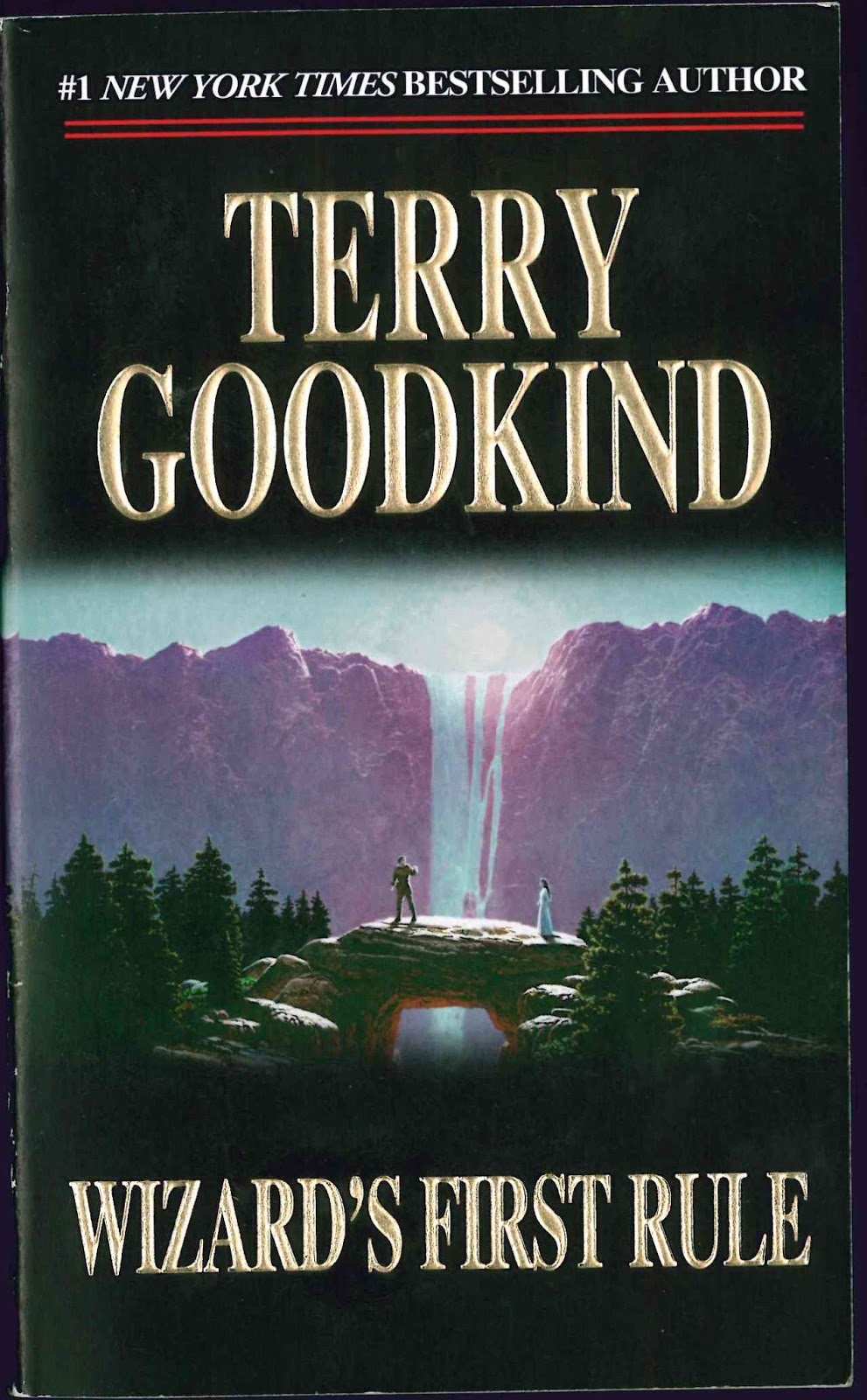
Wizard's First Rule
Yesterday I finished the first volume of Terry Goodkind's Sword of Truth series and am excited to report I really enjoyed it. Wizard's First Rule is not a new release, it's been around since 1994 according to the copyright, but I picked it up on recommendation and am glad I did. The story is high fantasy in that the fate of the world hangs in the balance as the main characters try to defeat the great evil and save everyone from slavery or worse. The characters are well developed and believable and so is the plot, well for fantasy. The book is long at over 800 pages and the first in a multi-volume series that I believe is still ongoing. I have seen the book various times and probably passed it by because of the size. I generally prefer my pleasure reading to be full of action and to move along swiftly and I have sometimes found that thick books move slowly. Wizard's First Rule is full of suspense and action and things move along as fast as I could wish for.
I won't give spoilers by talking about plot, but I will say I easy got involved with the characters and there are several tense scenes in the book that were quite emotional. Mr. Goodkind knows well how to tap into the reader's emotions as well as our sense of morality. Some of the evil deeds are a bit shocking, at least to me, but there is no doubt who is evil and bad here. I often gravitate to less morally distinct stories, ones where the boundaries between good and evil may be blurred and the heroes seem a bit rascally, but this book really made me think a bit about the nature of good and evil. I enjoyed that.
The reason I like to write about books on this blog is that I really believe reading is such a good way to stretch our imagination, adding images to our mental storehouse that we can then draw upon while refereeing or playing the game. Wizard's First Rule is 800+ pages of good ideas that can inspire us as gamers as well as entertain us as readers.
Yesterday I finished the first volume of Terry Goodkind's Sword of Truth series and am excited to report I really enjoyed it. Wizard's First Rule is not a new release, it's been around since 1994 according to the copyright, but I picked it up on recommendation and am glad I did. The story is high fantasy in that the fate of the world hangs in the balance as the main characters try to defeat the great evil and save everyone from slavery or worse. The characters are well developed and believable and so is the plot, well for fantasy. The book is long at over 800 pages and the first in a multi-volume series that I believe is still ongoing. I have seen the book various times and probably passed it by because of the size. I generally prefer my pleasure reading to be full of action and to move along swiftly and I have sometimes found that thick books move slowly. Wizard's First Rule is full of suspense and action and things move along as fast as I could wish for.
I won't give spoilers by talking about plot, but I will say I easy got involved with the characters and there are several tense scenes in the book that were quite emotional. Mr. Goodkind knows well how to tap into the reader's emotions as well as our sense of morality. Some of the evil deeds are a bit shocking, at least to me, but there is no doubt who is evil and bad here. I often gravitate to less morally distinct stories, ones where the boundaries between good and evil may be blurred and the heroes seem a bit rascally, but this book really made me think a bit about the nature of good and evil. I enjoyed that.
The reason I like to write about books on this blog is that I really believe reading is such a good way to stretch our imagination, adding images to our mental storehouse that we can then draw upon while refereeing or playing the game. Wizard's First Rule is 800+ pages of good ideas that can inspire us as gamers as well as entertain us as readers.
Thursday, April 27, 2017
Box of Tenticled Terror
Spooky RPG Fun
Sandy Petersen's Call of Cthulhu RPG was released in 1981. My friend and I attended GenCon that year at the University of Wisconsin, Parkside and I recall Call of Cthulhu (CoC) being my big purchase that year. I have acquired many games in my 40 years in the hobby, only a few stand out as "major" purchases - those that have had a profound affect on my experience with the hobby. CoC is one such game. The fantasy genre was my preference for role-playing with an emphasis on dungeon delving. I had experimented with a few games outside the fantasy genre, including Boot Hill and Gama World, Traveler and a Star Trek game all come to mind, but nothing seemed to satisfy my desire for adventure like White Box had. CoC was a totally new experience for me and would forever change my way of playing an RPG.
Player Characters in CoC are called "Investigators", because that's what they do. They aren't "Fighting Men" or "Magic Users". They ask questions, explore and discover. They sometimes fight, but often that is a fatal choice, ordinary people having little chance against the horrific monstrosities which can be encountered in a CoC game. Contact with such other-worldly beings can result in sanity loss even if the PCs physically survive. So playing at this weird 1920s investigator game I started to ask questions I thought my character should ask (rather than hitting everything with my sword). The referee (Keeper in CoC terms) probably talked in different voices for the NPCs and so somehow I got the idea that my character might have a different voice than the one I usually conversed with. The gun in my pocket tended to stay there and I talked my way through most encounters, all the while collecting information and uncovering plots. A camera often came in more handy than a weapon as it could provide proof to authorities that something unusual was afoot.
Interest in the game led to my exploring its source inspiration, the writings of H.P. Lovecraft and eventually others in the horror genre. Comics focused on weird tales had always been a favorite and horror movies I found thrilling, but converting those interests into gaming had not really occurred to me until Mr. Petersen showed us the way. CoC began to influence my other RPG play through incorporation of more role-playing elements and some horror themes. Our games got weirder in general after CoC.
Eventually I discovered that CoC could be taken outside the 1920s and I began running a game set in Outremer during the crusades for my friends. The dark ages seemed to add to the sense of mystery and wonder as the players explored exotic locales and uncovered ancient secrets. The mythos can really be used in any era from past, present and into the future depending on the preferred setting and lends itself well to alternative explanations for all sorts of events through the ages. Anything from the Fall of Rome to the Fukushima reactor disaster can be connected to mythos activity by an imaginative Keeper. And because the threat is always there, it can be fun to play out some scenarios lacking in anything really weird and unusual. Such sessions can lend verisimilitude to the game in general.
The game is now enjoying renewed popularity with the publication last year of the 7th Edition rules. The game design, originally based on the Basic Role Playing engine, has proven very robust and the 7th Edition remains essentially the same game it has always been, although I think there are some nice additions (and the books themselves are simply gorgeous). The d100 system is intuitive and I find it easy to run (provided previously created characters are available) even without the rule book present. The game can be rail-roady if the Keeper doesn't make an effort to avoid this and it can bog down if the Investigators fail to acquire an essential piece of information, therefore it is essential that the Keeper not allow a failed roll, or ignored lead, to stymie the game. Creativity and improvisation on the part of the Keeper can remedy these potential pitfalls. Some of the best CoC advice I ever got was to give the clue even though a roll is failed, just add a complication due to the failed roll. That way the game can progress and may even become more interesting.
White Box began as a game extension of fantasy literature. Mr. Petersen and Chaosium took the idea beyond fantasy and into the weirdness of the Cthulhu mythos of H.P. Lovecraft. In doing so, they expanded the scope of the hobby and gave me a game that took my experience way beyond the way I played White Box. It wasn't long before I took those experiences and new gaming concepts back to White Box and fantasy gaming. One part of the hobby enriches another.
Sandy Petersen's Call of Cthulhu RPG was released in 1981. My friend and I attended GenCon that year at the University of Wisconsin, Parkside and I recall Call of Cthulhu (CoC) being my big purchase that year. I have acquired many games in my 40 years in the hobby, only a few stand out as "major" purchases - those that have had a profound affect on my experience with the hobby. CoC is one such game. The fantasy genre was my preference for role-playing with an emphasis on dungeon delving. I had experimented with a few games outside the fantasy genre, including Boot Hill and Gama World, Traveler and a Star Trek game all come to mind, but nothing seemed to satisfy my desire for adventure like White Box had. CoC was a totally new experience for me and would forever change my way of playing an RPG.
Player Characters in CoC are called "Investigators", because that's what they do. They aren't "Fighting Men" or "Magic Users". They ask questions, explore and discover. They sometimes fight, but often that is a fatal choice, ordinary people having little chance against the horrific monstrosities which can be encountered in a CoC game. Contact with such other-worldly beings can result in sanity loss even if the PCs physically survive. So playing at this weird 1920s investigator game I started to ask questions I thought my character should ask (rather than hitting everything with my sword). The referee (Keeper in CoC terms) probably talked in different voices for the NPCs and so somehow I got the idea that my character might have a different voice than the one I usually conversed with. The gun in my pocket tended to stay there and I talked my way through most encounters, all the while collecting information and uncovering plots. A camera often came in more handy than a weapon as it could provide proof to authorities that something unusual was afoot.
Interest in the game led to my exploring its source inspiration, the writings of H.P. Lovecraft and eventually others in the horror genre. Comics focused on weird tales had always been a favorite and horror movies I found thrilling, but converting those interests into gaming had not really occurred to me until Mr. Petersen showed us the way. CoC began to influence my other RPG play through incorporation of more role-playing elements and some horror themes. Our games got weirder in general after CoC.
Eventually I discovered that CoC could be taken outside the 1920s and I began running a game set in Outremer during the crusades for my friends. The dark ages seemed to add to the sense of mystery and wonder as the players explored exotic locales and uncovered ancient secrets. The mythos can really be used in any era from past, present and into the future depending on the preferred setting and lends itself well to alternative explanations for all sorts of events through the ages. Anything from the Fall of Rome to the Fukushima reactor disaster can be connected to mythos activity by an imaginative Keeper. And because the threat is always there, it can be fun to play out some scenarios lacking in anything really weird and unusual. Such sessions can lend verisimilitude to the game in general.
The game is now enjoying renewed popularity with the publication last year of the 7th Edition rules. The game design, originally based on the Basic Role Playing engine, has proven very robust and the 7th Edition remains essentially the same game it has always been, although I think there are some nice additions (and the books themselves are simply gorgeous). The d100 system is intuitive and I find it easy to run (provided previously created characters are available) even without the rule book present. The game can be rail-roady if the Keeper doesn't make an effort to avoid this and it can bog down if the Investigators fail to acquire an essential piece of information, therefore it is essential that the Keeper not allow a failed roll, or ignored lead, to stymie the game. Creativity and improvisation on the part of the Keeper can remedy these potential pitfalls. Some of the best CoC advice I ever got was to give the clue even though a roll is failed, just add a complication due to the failed roll. That way the game can progress and may even become more interesting.
White Box began as a game extension of fantasy literature. Mr. Petersen and Chaosium took the idea beyond fantasy and into the weirdness of the Cthulhu mythos of H.P. Lovecraft. In doing so, they expanded the scope of the hobby and gave me a game that took my experience way beyond the way I played White Box. It wasn't long before I took those experiences and new gaming concepts back to White Box and fantasy gaming. One part of the hobby enriches another.
Wednesday, April 26, 2017
An Important Article
Clarifications & Explanations
The Strategic Review was the first magazine (fanzine really) published by the then new Tactical Studies Rules company. It covered the hobby and included articles on boardgames and minatures gaming as well as the new role-playing aspect of the hobby introduced by White Box. Vol. 1, No. 2 (Summer 1975) carried an article titled "Questions Most Frequently Asked About Dungeons & Dragons Rules" in which some important answers are given, presumably by author Gary Gygax himself.
Combat is the first topic addressed in the article and this seems appropriate given the White Box emphasis on combat. The author points out that Chainmail is primarily a 1:20 scale ruleset and suggests that the alternative system (d20) be used for important fights involving characters. It is in this article that the idea of fighting men getting multiple attacks against "normal" types such as 1 hit die monsters. The author states that an 8th level superhero would get eight attacks against normal men or their equivalent, i.e kobolds, goblins, gnomes, dwarves, etc. The omission of initiative in the White Box is addressed by the suggestion a d6 is rolled by each side and the higher score going first. This is done each round. A high dexterity can grant a bonus of +1.
The combat example given makes it clear how multiple attacks and initiative work and also introduces the concept of grappling and stunning. In the example a group of orcs attempt to grapple and overpower, i.e. capture a hero (4th level fighting man). When the hero tosses aside the unsuccessful orcs, he stuns two of them. Overpowering to capture rather than attack to kill seems an important tactic to remember.
Morale is discussed and the author states the PC morale is determined by the player and their choices. Monsters run by the referee are subject to morale unless they are mindlessly attacking, such as would be the case with undead. Some NPC henchmen and hirelings may occasionally be subject to morale. The author suggests using the morale system from Chainmail or a simple two d6 roll with 2 being very bad morale and 12 being very good morale.
Experience in White Box is primarily earned by recovering treasure. Killing monsters earns somewhat less experience. In this article, the author indicates magic items are worth relatively small amounts of experience because they aid the player in gaining more treasure and therefore have their own worth.
Any uncertainty regarding spell use is dispelled by the author who clearly states in this article that a given spell can be used but once per day. The magic user or cleric may "equip himself with a multiplicity of the same spell so as to have its use more than a single time". It is also stated that the rules assume the user of magic gains new spells by preparations such as memorization of incantations and that once spoken, that memory is gone completely. Scrolls work similarly in that the words are inscribed on the scroll and once spoken disappear completely.
The Strategic Review is a relatively amateurish publication and this issue is only 8 pages in length (Vol. 2, No. 2 is the last and longest issue with 24 pages.). Only seven issues were printed before TSR replaced it with Dragon Magazine and the short-lived Little Wars. Having been involved with fanzines for years, Mr. Gygax seemed committed to having a periodical publication to support his products and the hobby in general as part of his new company. As can be seen on the cover above, this issue is dedicated to the memory of Mr. Gygax's first business partner and long-time friend Don Kaye (hence the GK logo).
The Strategic Review was the first magazine (fanzine really) published by the then new Tactical Studies Rules company. It covered the hobby and included articles on boardgames and minatures gaming as well as the new role-playing aspect of the hobby introduced by White Box. Vol. 1, No. 2 (Summer 1975) carried an article titled "Questions Most Frequently Asked About Dungeons & Dragons Rules" in which some important answers are given, presumably by author Gary Gygax himself.
Combat is the first topic addressed in the article and this seems appropriate given the White Box emphasis on combat. The author points out that Chainmail is primarily a 1:20 scale ruleset and suggests that the alternative system (d20) be used for important fights involving characters. It is in this article that the idea of fighting men getting multiple attacks against "normal" types such as 1 hit die monsters. The author states that an 8th level superhero would get eight attacks against normal men or their equivalent, i.e kobolds, goblins, gnomes, dwarves, etc. The omission of initiative in the White Box is addressed by the suggestion a d6 is rolled by each side and the higher score going first. This is done each round. A high dexterity can grant a bonus of +1.
The combat example given makes it clear how multiple attacks and initiative work and also introduces the concept of grappling and stunning. In the example a group of orcs attempt to grapple and overpower, i.e. capture a hero (4th level fighting man). When the hero tosses aside the unsuccessful orcs, he stuns two of them. Overpowering to capture rather than attack to kill seems an important tactic to remember.
Morale is discussed and the author states the PC morale is determined by the player and their choices. Monsters run by the referee are subject to morale unless they are mindlessly attacking, such as would be the case with undead. Some NPC henchmen and hirelings may occasionally be subject to morale. The author suggests using the morale system from Chainmail or a simple two d6 roll with 2 being very bad morale and 12 being very good morale.
Experience in White Box is primarily earned by recovering treasure. Killing monsters earns somewhat less experience. In this article, the author indicates magic items are worth relatively small amounts of experience because they aid the player in gaining more treasure and therefore have their own worth.
Any uncertainty regarding spell use is dispelled by the author who clearly states in this article that a given spell can be used but once per day. The magic user or cleric may "equip himself with a multiplicity of the same spell so as to have its use more than a single time". It is also stated that the rules assume the user of magic gains new spells by preparations such as memorization of incantations and that once spoken, that memory is gone completely. Scrolls work similarly in that the words are inscribed on the scroll and once spoken disappear completely.
The Strategic Review is a relatively amateurish publication and this issue is only 8 pages in length (Vol. 2, No. 2 is the last and longest issue with 24 pages.). Only seven issues were printed before TSR replaced it with Dragon Magazine and the short-lived Little Wars. Having been involved with fanzines for years, Mr. Gygax seemed committed to having a periodical publication to support his products and the hobby in general as part of his new company. As can be seen on the cover above, this issue is dedicated to the memory of Mr. Gygax's first business partner and long-time friend Don Kaye (hence the GK logo).
Friday, April 21, 2017
Referee Reading
Ideas for the Game
Kurt Wiegel on his Game Geeks Youtube channel recently expressed the opinion that GMs/referees should read a lot. I agree. Reading is a great way to collect ideas that can later be used in whole, in part, or just as inspiration for a game session you are running. The more one reads, especially history or fiction, the more useful material one is exposed to. Plots, characters, and events can all be used as fodder for your imagination mill. Re-skinning a story by changing the setting, the names of the people involved and some of the insignificant details can be one of the best ways to quickly come up with a game scenario. Where you draw that story from can vary quite a bit.
I find old western movies to be a great source of story. They don't even have to be very good movies, in fact often the weaker film plots turn out to be more useful as a game template than the more complex, better movies. Simple is good. Characters can be lifted and their hat and six-gun exchanged for medieval garb and again the most simple, stereotyped ones are often the best. Another source I frequently mine for story and character is comic books. The plots are often straight-forward and the villains and supporting cast iconic and easy to understand. Very complex plots or complex characters are difficult for me to successfully translate onto the gaming table. Music is often an inspiration for my gaming as well. Lyrics can suggest characters and story while the sounds inspire mood and atmosphere elements. Pictures often enter my imagination as I listen to music and the music can become a backdrop to an idea I work out mentally while listening.
Reading exercises the imagination. Being able to picture, in one's mind, the setting and action being described in writing is using one's imagination. The imagination, so essential to tabletop gaming, is like a muscle. it responds to exercise by getting stronger. The more we use our imagination, the stronger our imagination becomes. Imagining the possible is helpful in life as well as gaming. An active imagination allows us to think outside the box and be more creative. I am a big fan of the imagination.
Having just finished Glen Cook's excellent The Black Company series and looking for my next fantasy read, I took the advice of Sean Patrick Fannon who in his excellent Shaintar: Legends Arise setting book recommends The Fionavar Trilogy by Guy Gavriel Kay and the Belgariad novels of David Eddings (among others) and ordered the trilogy and the first three Belgariad volumes. They are older '80s fantasy which means the stories are likely heavily Tolkien influenced and rather epic in nature. I am hoping to find them fertile ground for picking up ideas for use as referee as well as an entertaining read.
Kurt Wiegel on his Game Geeks Youtube channel recently expressed the opinion that GMs/referees should read a lot. I agree. Reading is a great way to collect ideas that can later be used in whole, in part, or just as inspiration for a game session you are running. The more one reads, especially history or fiction, the more useful material one is exposed to. Plots, characters, and events can all be used as fodder for your imagination mill. Re-skinning a story by changing the setting, the names of the people involved and some of the insignificant details can be one of the best ways to quickly come up with a game scenario. Where you draw that story from can vary quite a bit.
I find old western movies to be a great source of story. They don't even have to be very good movies, in fact often the weaker film plots turn out to be more useful as a game template than the more complex, better movies. Simple is good. Characters can be lifted and their hat and six-gun exchanged for medieval garb and again the most simple, stereotyped ones are often the best. Another source I frequently mine for story and character is comic books. The plots are often straight-forward and the villains and supporting cast iconic and easy to understand. Very complex plots or complex characters are difficult for me to successfully translate onto the gaming table. Music is often an inspiration for my gaming as well. Lyrics can suggest characters and story while the sounds inspire mood and atmosphere elements. Pictures often enter my imagination as I listen to music and the music can become a backdrop to an idea I work out mentally while listening.
Reading exercises the imagination. Being able to picture, in one's mind, the setting and action being described in writing is using one's imagination. The imagination, so essential to tabletop gaming, is like a muscle. it responds to exercise by getting stronger. The more we use our imagination, the stronger our imagination becomes. Imagining the possible is helpful in life as well as gaming. An active imagination allows us to think outside the box and be more creative. I am a big fan of the imagination.
Having just finished Glen Cook's excellent The Black Company series and looking for my next fantasy read, I took the advice of Sean Patrick Fannon who in his excellent Shaintar: Legends Arise setting book recommends The Fionavar Trilogy by Guy Gavriel Kay and the Belgariad novels of David Eddings (among others) and ordered the trilogy and the first three Belgariad volumes. They are older '80s fantasy which means the stories are likely heavily Tolkien influenced and rather epic in nature. I am hoping to find them fertile ground for picking up ideas for use as referee as well as an entertaining read.
Thursday, April 20, 2017
Gnome, Gnoll & Troll
A Discourse on Genetics
Long before the hyena man made his appearance in the Monster Manual, Gnolls were being encountered and bested by hardy adventurers. The White Box Gnoll is described in Volume 2, Monsters & Treasure as "A cross between Gnomes and Trolls", hence the name. Gnolls are a bit tougher than Hobgoblins (big hairy Goblins) having 2 full hit dice (as opposed to 1+1 for Hobgoblins). Presumably they look something like a mixture of Gnome features and Troll features. The illustration from Vol. 2 shown above seems to confirm this. Gnomes are described as short and bearded like dwarves, Trolls as greenish, rubbery and thin. They lack the regenerative power of the Troll, but the bigger Gnolls fight as 6+3 hit dice monsters just like Trolls. Obviously they are weapon users (unlike Trolls who rely upon their claws).
The Monster Manual of the Advanced game alters the Gnoll's appearance to resemble hyena men, otherwise much of the description is similar. They retain a greenish hue to their skin. Game statistics including Armor Class and Hit Dice remain the same. They even speak Troll as if perhaps the relationship with Trolls remains, but is unstated. They are clearly depicted as slavers in the Monster Manual and are generally found below ground often in competition with and/or cooperation with Hobgoblins, Orcs, Bugbears, Ogres and Trolls. They keep hyenas and hyenadons as pets.
In Volume 2, Monsters & Treasure there is an obscure reference to a "Lord Sunsany" who is credited with the theory that Gnolls are a cross between Gnomes and Trolls, but he "did not really make it all that clear". I wonder which came first, the name or the monster. A quick search reveals that Gnoles appear in stories by Lord Dunsany, "How Nuth Would Have Practiced His Art Upon The Gnoles" and Margaret St. Claire, "The Man Who Sold Rope To The Gnoles". Is "Lord Sunsany" actually Lord Dunsany?
Immersion in the game and our willingness to suspend disbelief and treat the imaginary world as real in order to more fully enjoy the game can lead us to think of its troupes as realities. So how would a dwarf-like race of Gnomes cross-breed with Trolls, a traditional enemy of the dwarves and presumably the Gnomes. In Volume 1, Men & Magic Dwarves and Gnomes are listed on both the Law and Neutrality lists while Trolls and Gnolls are certainly Chaos creatures. I would think this alone would make them enemies. Of course this may not preclude violent interbreeding.
Magic is another possible explanation for the Gnoll. Chaos magic users may have experimented with various racial combinations and be responsible for combining Gnome and Troll DNA to create the race of Gnolls. I rather prefer this "magical" explanation.
The somewhat primitive and amateurish drawing of the Gnoll in White Box gives me the impression of a rather large, stooping fiend, with an evil, teeth baring grin and bulging eyes. I can easily picture the Gnoll as a formidable adversary for a low level character. How ever the referee interprets the Gnoll's heritage, Gnolls provide yet another bad guy race to flesh out for your campaign, distinct from Orcs, Hobgoblins, Ogres, Bugbears and the rest of the humanoids. That's where the fun comes into play, using our imagination to create something uniquely ours, then sharing it with friends.
Long before the hyena man made his appearance in the Monster Manual, Gnolls were being encountered and bested by hardy adventurers. The White Box Gnoll is described in Volume 2, Monsters & Treasure as "A cross between Gnomes and Trolls", hence the name. Gnolls are a bit tougher than Hobgoblins (big hairy Goblins) having 2 full hit dice (as opposed to 1+1 for Hobgoblins). Presumably they look something like a mixture of Gnome features and Troll features. The illustration from Vol. 2 shown above seems to confirm this. Gnomes are described as short and bearded like dwarves, Trolls as greenish, rubbery and thin. They lack the regenerative power of the Troll, but the bigger Gnolls fight as 6+3 hit dice monsters just like Trolls. Obviously they are weapon users (unlike Trolls who rely upon their claws).
The Monster Manual of the Advanced game alters the Gnoll's appearance to resemble hyena men, otherwise much of the description is similar. They retain a greenish hue to their skin. Game statistics including Armor Class and Hit Dice remain the same. They even speak Troll as if perhaps the relationship with Trolls remains, but is unstated. They are clearly depicted as slavers in the Monster Manual and are generally found below ground often in competition with and/or cooperation with Hobgoblins, Orcs, Bugbears, Ogres and Trolls. They keep hyenas and hyenadons as pets.
In Volume 2, Monsters & Treasure there is an obscure reference to a "Lord Sunsany" who is credited with the theory that Gnolls are a cross between Gnomes and Trolls, but he "did not really make it all that clear". I wonder which came first, the name or the monster. A quick search reveals that Gnoles appear in stories by Lord Dunsany, "How Nuth Would Have Practiced His Art Upon The Gnoles" and Margaret St. Claire, "The Man Who Sold Rope To The Gnoles". Is "Lord Sunsany" actually Lord Dunsany?
Immersion in the game and our willingness to suspend disbelief and treat the imaginary world as real in order to more fully enjoy the game can lead us to think of its troupes as realities. So how would a dwarf-like race of Gnomes cross-breed with Trolls, a traditional enemy of the dwarves and presumably the Gnomes. In Volume 1, Men & Magic Dwarves and Gnomes are listed on both the Law and Neutrality lists while Trolls and Gnolls are certainly Chaos creatures. I would think this alone would make them enemies. Of course this may not preclude violent interbreeding.
Magic is another possible explanation for the Gnoll. Chaos magic users may have experimented with various racial combinations and be responsible for combining Gnome and Troll DNA to create the race of Gnolls. I rather prefer this "magical" explanation.
The somewhat primitive and amateurish drawing of the Gnoll in White Box gives me the impression of a rather large, stooping fiend, with an evil, teeth baring grin and bulging eyes. I can easily picture the Gnoll as a formidable adversary for a low level character. How ever the referee interprets the Gnoll's heritage, Gnolls provide yet another bad guy race to flesh out for your campaign, distinct from Orcs, Hobgoblins, Ogres, Bugbears and the rest of the humanoids. That's where the fun comes into play, using our imagination to create something uniquely ours, then sharing it with friends.
Subscribe to:
Posts (Atom)