Monday, September 23, 2024

Poets & Writers of Adventure take heed

Nexus Gates in Arduin
It has been too long since I last visited the world of Arduin, certainly one of the most magikal places in the adventure gaming multiverse. 
Arduin is everywhere. (It says so in the book!)
Arduin is full of ideas, inspiration and enthusiasm for the hobby.
The possibilities are limited only by what you can imagine.


I've kept it no secret that my enthusiasm for the hobby has been flagging o' these recent months. "Disappointment" is my preferred way to describe my feelings toward the current state of affairs. The OSR, once a bright spot for me has gone dark, having succumbed to the usual "differences of opinion". This prevalence seems to plague every aspect of our current culture - online and otherwise. 
As for the corporate side of the hobby, well the less said these days, the better. (and I don't desire to add to the "differences of opinion" by restating mine)
And then there is my disagreement with friends over "stuff" - everything from "what system to play" to who is, or is not, to blame for whatever ills we personally put front and center in our general "talking points" (anger is not a fun emotion to experience or to witness). Ho-Hum, and a sad sigh of despair...


Hence, I find myself casting about, searching for something to bring me cheer.
Enter Arduin...the off-the-rails imaginings of a free-spirited gamemaster, first published 40 years ago the words expressed in the pages of the Arduin Grimoire always seem fresh and full of excitement. For its multitude of possibilities, upbeat mood and fresh ideas that are brought into our hobby through its magikal "gates". A quick perusal of even one grimoire will reveal many ideas that first appeared in the pages of Arduin's "Grimoires" and have later reappeared in the wider hobby. Innovation!


Arduin began life as the personal game world of David Hargrave during the early days of the hobby, before there was an attempt to codify and control how people played the game. It is an artifact of its time, yet it remains relevant today. The publications have evolved and content has been added to by others who were inspired by the creativity of Mr. Hargrave. I consider myself fortunate - I have entered the nexus gates through the pages of Arduin many times. 


I have yet to find the outer limits of the creative imaginings contained within Arduin. Each journey to Arduin reveals new territory and is a fantastic discovery. Casting about online, I know mine is not a unique experience and others have encountered similar feelings. If you would journey forth through the gates to Arduin, you will find it is only a mouse click or two away. Many of the grimoires remain available, kept alive by a devoted following.
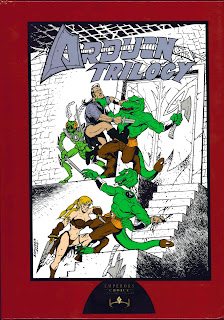

Each time I delve into Arduin I find it to be renewing, and energizing, and captivating. The genius of David Hargrave flows forth across the multiverse and seems timeless. What a gift!

Friday, July 5, 2024

Failing Nation

Drawing Inspiration from History.
On several occasions I have heard those who design fictional worlds, either for their novels or as a setting for games, remark that they look to history for inspiration. I have frequently shared my opinion about preaching with the Bible in one hand and a newspaper in the other. I have also remarked that I find old westerns to often have simple story plots that are easily adapted for use at the gaming table. Today I offer for gaming consideration my latest observation taken from current events, the failed nation scenario.
Conflict makes for good story-telling. The protagonist(s) in a story need something to do. A society under stress from the failure of its institutions and the subsequent chaos and struggles, perhaps to even survive, can make for a good gaming scenario. Any time there is an uncertain outcome, one which may be affected by the actions of our player character protagonists, there exists the protentional for rewarding game-play.
The universality of the scenario lends itself to use across many genres. Grab a year near the fall of Rome for a quasi-historical campaign, or set the space-age action on a faraway planet that is now abandoned and forgotten by the Empire in Decline. Give some thought to the many ways decline and fall may affect the citizens and pause to consider the opportunities a vacuum in power might offer.
By changing the names, adding fictional details drawn from our own imagination and creating an interesting cast of characters we may develop a setting ripe with possibilities for game-play. 
For example, the Legend of King Arthur is set in a time when the military might of Rome withdrew from Britain leaving its citizens to govern themselves, and to protect themselves from migratory invaders. Under Roman rule, the Britons had enjoyed a degree of prosperity that perhaps made their country attractive to their less well-off neighbors. In-fighting among the Britons who disagreed over who and how the power void should be filled, further weakens their resistance to raids and invasion. Re-skin the scenario as a space-age planetary adventure setting and we have alien invaders threatening an isolated outpost in turmoil and technological decline. Who will arise to lead the resistance? Will the PCs take up the mantel of legendary hero, or perhaps see the situation as an opportunity to go treasure seeking among the ruins left in the wake of war?

Monday, June 24, 2024

Taking Your Game Beyond RAW

Looking Back to the Future of our Hobby
In this the 50th anniversary year of the publishing of the world's first fantasy role-playing game I suppose it is only natural to look back on our personal history with the game at the center of our shared hobby. Each of us has a unique journey and every story has some merit, if only to those who personally lived it. A message board, a blog or video channel or podcast can be an outlet for those memories and hopefully share some insight.
I came to the hobby during a time when everyone added some personal customization to the game. The year 1977 saw the publication of the first "Basic" version of D&D in response to a perceived need for a version of the rules that would be more user friendly than the collection of little brown volumes that had been published up to that date. The original game had grown by leaps and bounds, both in terms of popularity and in terms of available support material. The original three volumes had grown to include five volumes, not to mention Chainmail on which the game mechanics were originally based. Various supplemental ideas were floated in the official TSR publications Strategic Review and Dragon Magazine often penned by co-creator Gygax himself, but even more frequently by one of a host of amateur hobby enthusiasts. In this way we in the hobby received new character classes, new monsters and new ways to implement rulings at our table. Some might describe this situation as a hodge-podge or miscellany. 
I found it much to my liking. As an enthusiast of games in all their varied forms, I found the idea that the rules to a game could be added to, modified or even rewritten by the players to be immensely empowering. Anything was possible - and wasn't that the point of fantasy? 
The essence of the hobby for me is imagining. To Imagine new worlds, new challenges, fictional characters, mysteries and yes, new ways to roll dice and to share stories is a delightful pastime. 
In the 1977 version of "Basic" there is reference to the "Advanced" game which was being developed alongside the introductory version product. The idea around which "Advanced" was being written was that the game rules needed a standardized version to facilitate tournament play involving players from all over who obviously could benefit from knowing how the rules were going to be applied at any given table. An obvious answer to a recognized challenge was for the "creator" of the game to give/sell the hobby an "official" version of the rules. This was an undertaking of some proportion and it understandably took time for this one person, who had other responsibilities running a company, and having a family. The volumes comprising the "Advanced" game were released over a number of years and ultimately all were necessary to complete the game. In the meanwhile, we gamers would continue to play the game we loved with whatever mix of officially published rules we had available or could improvise using other sources and our imaginations.
And of course the game's development didn't stop with publication of the "Advanced" rules.
For members of the tabletop role-playing hobby there are so many ways to play today. We are a hobby that is blessed (and cursed) to have games that reflect a variety of preferences, approaches, themes and sensibilities which we can choose from and sometimes argue about. 
If I think about it, this has always been the case. Arguments were frequent in the days before we were given the "Advanced" rules that were meant to standardize play. The publication of "Advanced" didn't settle all of the disputes and Sage Advice often gave conflicting interpretations on various rules questions. Of course the publication of "Advanced" didn't meet everyone's desires and various "homebrew heartbreaker" versions of the game were also published (should we also include "Basic/Expert"). Choices can lead to disagreement. 
 So what are some lessons of a half century of tabletop role-playing as a hobby?
The publishers of the game want to sell you a new book.
There is no "one game" that will appeal to everyone in this hobby.
Homebrewed rules and rulings can feel arbitrary and unfair to players.
Rules lawyering and attempts to game the system can be a frustration to the referee/GM.
Playing a game is about cooperation.
At the end of the day, it's just a game - one that we can hopefully play for fun and shared enjoyment.

Friday, June 21, 2024

1974 & Beyond

Fifty Years Ago...
A couple of middle-aged gamers and lifetime friends (named Kaye and Gygax) pooled their resources and self published the world's first fantasy role-playing game. The kernel of ideas which inspired Mr. Gygax to write said rules came from other gamers who traveled from Minnesota and shared their innovative style of game play with the Wisconsin group including Mr. Gygax.  About three years later I stumbled upon the game designed by Misters Gygax and Arneson and have played one version or another of said game right up to the present. Along the way, I rather fancy that I may have learned a few things about life, friendship and shared gaming. Some of those lessons find their way into this blog.

Creativity and imagination are the only absolutely necessary components of play. Mr. Gygax and Mr. Arneson gave us gamers a new way to play a game. We imagine fantastical worlds, can populate our shared fantasy with heroes, villains and various imaginary beings, and tell each other stories about what happens in this shared imaginary space, all while playing a game. It's all make-believe, but with some guidelines and mutual buy-in, it's also a game. The actual mechanics of our particular game are often less important than the game publisher would like us to believe.
What we bring to the game table in terms of experience, especially the books we have read including the stories that will inspire and focus our imagination, is  more important in many ways than the specific game we choose to play. Our individual imagination is what shapes the character of the setting we imagine, the action that takes place and the wonder of it all as we experience it. Without a point of reference, without examples we are limited in what we can imagine. Imagination is like so many other human capacities in that our ability to make use of it improves with practice. The more imaginings we take in, the more we have at our disposal when we start to create (borrow, steal from or be inspired by) and the more varied and interesting our creations are likely to be. The best advice I have heard (and I have sought lots of advice over the years) for improving our game is to read everything you can asking yourself all the while, "How can I use this in my game?"

As an exercise, let's imagine we are creating a story together. Let's agree that our story involves something we'll call "a goblin". What does our goblin look like? You tell me.
Most of you reading this blog have some concept of what a goblin is that is based on various sources you have encountered over your lifetime. Obviously, there is no real "goblin" to compare our version to or that can definitively establish what a goblin looks like. The only thing that really matters regarding our goblin's appearance is that we share certain assumptions regarding the nature of our goblin in order for us to develop our story. 
Let's agree that our goblin is a short, bestial and mischievous creature that otherwise resembles a human. Let's say, the goblin is threatening and waving a rusty sword at us. Slobber and spit runs down its sloping chin as it grins evilly and advances upon us. What do we do?
Imagine!

The game will likely involve us rolling some dice, it's a game after all. The outcome will contain some degree of doubt until the conflict is resolved and not knowing what may happen before is part of the fun. The result is our shared "story" we have just imagined together.
It's really that simple. Regardless of the particular rule mechanic we are using, the concept comes down to one person describing the situation, then perhaps another person deciding what action to attempt, then we insert some game mechanics and describe the outcome. 

So one may ask, does the game system really matter at all?
I would say, yes it does. We all have our unique preferences in game mechanics (etc.) and since it is a "game" we are playing, each of us will find certain mechanical aspects more or less appealing and this will certainly affect our enjoyment while playing our game. (In my opinion, some mechanics fit certain styles of play better than others and are more likely to deliver a specific experience while playing.) Some systems are specifically geared to work well with certain genres and feel more or less "real" when playing under those assumptions. This and other preferences likely accounts for why there are so many game systems available today.   
Ultimately, the rules of a game come down to what is mutually acceptable among the players.
In 1974 there was only one game and it wasn't even called "role-playing" because nobody at that time would know what a role-playing game was. Today, fifty years later, we have thousands of games marketed as "role-playing". If you have read this far it should be obvious that I tend to view them all as "variations on a common marvelous theme".

Thursday, May 30, 2024

Yet more advice on How to Referee

Ideas Borrowed
If we have read J.R.R. Tolkien's The Hobbit we have an idea of how an adventure to defeat a dragon and take its treasure may begin, progress and even end. In the novel we are introduced to the concept of an adventuring party or "company" is comprised of individual characters possessing unique skills including warriors, a wizard and a burglar. We have some idea of how to describe a journey across the wilder lands, encounters with monsters and with helpful folk met along the way, and with the big "showdown" at the finale. In effect, we have the pattern for developing our own adventure story through game play.
Many a game of the world's most popular fantasy role-playing game has followed this model.
If we have read Fritz Leiber's Ill Met in Lankhmar we have before us the blueprint for an urban adventure. The novella Ill Met in Lankhmar features two companions , a fighting barbarian and thieving ex-wizard apprentice who dabble with romance, crime and intrigue with a thieves' guild, murder and arson, carousing, and other flavorful aspects to be found in a fantasy urban setting. Again, reading about Lankhmar prepares us to think through our own tabletop adventures in an urban fantasy setting.
The best referee advice I have come across to date is to run as many games as one can and play in as many games run by another as possible. 
Next to that, the next best referee advice I can think of is to read lots, and always with the thought in mind - Can I use this in my game?

Monday, May 20, 2024

The Hero's Journey

...From One Fool's Perspective.
The tabletop-roleplaying experience has at times been compared to the mythic "hero's journey" (see the works of Joseph Campbell and others if this topic intrigues you). My fool's understanding of the epic hero myth is that our hero starts small, learns from failure, then grows in stature so as to be able to achieve a great task. It is a story of metamorphosis, "from zero to hero" as it is often described in classical tabletop gaming circles.
A slight variation on the Journey theme is known as the "Fool's Journey", which is the journey from ignorance to enlightenment. Again our protagonist or "hero" starts as something small, a foolish person in this version, and through various adventures learns wisdom so as to eventually be redeemed and usually accomplish some good in the world often in spite of a poor understanding of the situation. In my eyes the two journeys are closely related.
So how is this discourse connected to tabletop gaming you may be asking? Our paper heroes are essentially on an epic journey to better themselves, to right wrongs and perhaps to save others from a dastardly fate that is being plotted by an evil villain. There are successes and failures along the way, but our paper hero, should they survive danger, will grow in stature and power so as to eventually be prepared to take on the "big bad evil" and through heroics, save the world. It is essentially an exercise in turning the "Journey" into a game.
With its roots (arguably) in literature, tabletop role-playing games have drawn inspiration from many versions of this classic myth cycle. Tales of King Arthur, the works of Professor Tolkien and the pulp adventure stories of authors such as Fritz Leiber and Robert E. Howard are all recognizable in the classic editions of the game (and specifically named in the Appendix). CRPGs often draw heavily from the TTRPG traditions and have frequently repeated this rags-to-riches character progression. The Hero's Journey is a concept that plays well with an audience who can imagine that a humble beginning is no barrier to a life of high adventure and heroic questing.
So my question today is what happens to the game when the journey ends before it begins? What is there to accomplish when our hero starts life as a nearly invincible protagonist, can easily defeat all challenges and when our "story" becomes a laundry list of various messes that we have cleaned up. The spectacular (and heroic) become the mundane?
Sometimes it feels just so.

Friday, May 3, 2024

Gateway to Another World

Fighting Fantasy and other adventure books offer the reader a chance to have a gaming experience much like role playing while reading a book (and rolling some dice), no friends required. The first in a series of the Fighting Fantasy logo books, The Warlock of Firetop Mountain, was written and published by Ian Livingston and Steve Jackson back in 1982 (it's still in print). The Fighting Fantasy books are a fun introduction to the concept of fantasy adventure gaming, or a nice diversion from gaming with a group and they have once again become an entertaining solo gaming experience for an old adventurer such as myself.
I recently re-visited The Warlock... and found this book still offers a fun challenge. The book is not an adventure that one is likely to complete on our first try/read and the author of the book warns us to expect to lose a few characters before we learn all the secrets of success. Yes, some might call this "metagaming" but the idea is to use what we learn from the last delve to help make wiser choices in the next attempt, even though it is with a fresh character.
Warlock is a classic fantasy setting complete with underground corridors inhabited by orcs and an evil warlock/mastermind to defeat. The game system is mechanically fairly simple, but it still offers all that is necessary to get the imagination going. The reader starts by "rolling up a character/adventurer" who is your imaginary self as you make choices and suffer the consequences of failure through damage to the character's stats. This should sound familiar to anyone who has played any tabletop roleplaying game. The Fighting Fantasy books use three stat scores, Skill, Stamina and Luck. Magic in the book is found in the form of potions and items and in the fantastic elements of the setting.
Skill is a generic ability score that represents combat prowess, sneaking about, tinkering with locks and traps and opening doors (and anything else that "skill" might cover). You test Skill by rolling two six sided dice and adding your Skill number for a total which is often compared to a monster's total (generated in the same manner) in combat or to a target number for a non-combat task.
Stamina is health or hit points and an adventurer loses Stamina when they take damage. Lost Stamina can be restored by taking time-out and eating a ration or by quaffing a "magic" potion.
Luck is tested in a manner similar to saving throws found in some other games and success can get you out of a bad situation or outcome. Luck diminishes as it is used/tested however and the Luck score is lowered by one each time it is rolled against. The player can also choose to test luck in an effort to inflict more damage on a on a monster as part of a successful attack or to reduce the amount of damage your character takes when the monster has won a round of combat. Luck is replenished by drinking a fortune potion or as a reward for accomplishing some task as instructed to do so in the text.
The adventure presented in The Warlock... book recently entertained me for most of a day as I worked my way through the tunnels, lost a few adventurers along the way and defeated the boss warlock. Revisiting the Fighting Fantasy system also inspired some ideas regarding modifying it for further solo or group play using some adventures of my own design involving some random dice roll tables. 
The idea of moving the FF game out of the book and onto the table is an obvious outgrowth of the system. The authors would publish their own Fighting Fantasy tabletop role-playing game doing just that in 1984. 
This book is no longer in print and therefore is a little harder to come by these days. Fortunately, the mechanics of the FF game system lend itself easily to adding homebrew innovations - and who doesn't enjoy making things up!


Tuesday, April 16, 2024

Columbia Games Print Option

HarnWorld - with an umlaut 
My initial purchases of  Columbia Games Harn line of role-playing game products, which as I recall was sometime in the late 1980s, were several saddle stitch (stapled) softcover books detailing regions of the island of Harn and a boxed product which includes maps (beautiful, color fold-out maps!) and paper covered and staple-bound booklets that describe in detail the world of Harn. These are traditional TTRPG fare in terms of the physical product and production format, but are quite unique in their content. I was (and remain) captivated by the world of Harn. At once the fictional world created by N. Robin Crossby is engaging. It contains elements borrowed from Tolkien, including that "vaguely familiar" feeling which any fiction based on dark-age European (or other) history provides, Harn wraps these elements in a novel interpretation that produces something delightfully fresh packed with wonderful details that make me want to explore this imaginary world.
My interest in the Harn setting has persisted and I have continued to add to my collection of materials based on the world Mr. Crossby created and others have continued to expand. The Harn products published by Columbia Games have often been marketed as loose leaf and three hole punched color pages to insert into a binder. It's an interesting choice that is both flexible and modular allowing the individual collector to assemble a binder that could include both published and home-brew contents. This is how Harn has been marketed, until recently. Starting a couple of years ago, Columbia Games began offering certain of their Harn products in bound hard-cover book format. I assume, based on the examples that I have purchased that this involves a technology very similar to print-on-demand. The material in the books is the same as what I see available in digital and loose-leave format, but the physical hard-cover book is nice to have and may be preferred by some. 
As I continue to ponder the possible futures of our hobby, I am also enjoying the diversity of product formats that are currently available. Digital has it's advantages - and disadvantages when compared to other formats. Physical books can be produced using traditional technologies of bookbinding or may involve newer technologies that have their own advantages and disadvantages depending on preference and comparison with other formats. All of this publishing thought interacts with how we use the products both in preparation and in play. (It's pretty easy to pull a map from a digital file and put it on-screen for remote players.)   
Honestly, I have no idea how to authentically pronounce many of the names I find in the Harn setting, but I suppose pronunciation is one of the ways each referee makes the setting their own. As you like it!


Monday, April 15, 2024

An End to the In-Print TTRPG

The Future is not certain, but...
One of my favorite tabletop role-playing game systems is GURPS - the Generic Universal Role-Playing System written by Steve Jackson and published by Steve Jackson Games. It was first released as a boxed set including cardboard stand-up "heroes", a tactical display map, game charts, character sheets and two soft-cover rulebooks providing me with everything needed to play (there may have been dice too, but I don't honestly recall this). The boxed first edition GURPS is a nice product that I still cherish as part of my collection. 
The game has received enormous support from Steve Jackson Games across several decades and is in its 4th edition with numerous physical and digital supplements available. The GURPS 4th edition Basic Set comprises two attractive hard-cover volumes subtitled Characters and Campaigns. 
Until recently, I could purchase them from the Steve Jackson Games online Warehouse 23 store as full-color books or as digital files. Since the beginning of the year, the color hardback physical copies have been labeled "Sold Out". The books are available as digital downloads and as print-on-demand black and white books either in hard-cover or soft-cover. The current options are nice enough and offer affordable ways to acquire the desired game materials, but I wonder what this change in print situation may portend for the future of our hobby?
Some years ago Steve Jackson Games started offering print-on-demand of their older edition GURPS material (which is a large catalog), some of this is through a popular online corporation that you can easily find for yourself (visit Steve Jackson Games and you will have no trouble) so I won't "advertise" the online market here by name. 
In the time that they have been available, I have ordered and received several volumes in this print-on-demand format thus rounding out my collection of older GURPS supplements (which still contains gaps since Steve Jackson Games publishes so much). I have no quibbles with the format or the quality of the print-on-demand products. I find the print-on-demand books are perfectly serviceable and the fact that this process enables us as the consumer a wider choice of what's available is definitely an advantage. Demand will always drive supply in a market economy. 
I enjoy reading on a tablet, but I like to have a physical book in my hands as well. It is not unlikely that I will have both if it's something I value and enjoy. Options and choice are generally a good thing as I see it. As things change as they constantly do, some changes seem to offer more and some changes seem to result in less. Not everyone sees a change from the same viewpoint (of course). I do wonder what print-on-demand spells for the future of brick & mortar game stores?
Steve Jackson Games is an innovator and not a small player in the tabletop game world. Is the switch to print-on-demand a temporary solution to an availability challenge in a changing logistical scenario or does it mark a transition in the way we will consume virtually all printed media going forward? My crystal ball isn't clear on this matter. If Steve Jackson is at the forefront of a new trend, it will not be the first time.


Tuesday, March 12, 2024

Be Good to Yourself

Play the game you want!
I am increasingly convinced that what we play, how we play, and who we play with matters.
We play games for the enjoyment it brings. Enjoyment naturally involves a number of factors and is individualistic. What is enjoyable to one person, may not be to another.
Throughout the decades, games have been a social thing for me and group play constituted my preferred way to participate in this hobby. This is one of the reasons why I have only dabbled infrequently into the video and computer RPGs, but I never really devoted myself to that aspect of the gaming pastime. It's also a contributing factor to my hesitation around playing online. I honestly prefer the comradery and interpersonal interaction associated with in-person play around a physical table.
However...
There comes a time when not everyone can agree on the system to play, on the schedule of game-day or time, or on one or more of any of the myriad of other factors upon which modern humans find reasons to disagree. 
I currently find myself faced with a choice of playing at a game that I don't enjoy, one that centers on a style of play I find less than appealing, and is published by a corporation that seems intent on alienating a segment of the FRP gaming hobby as they brand their way to success, or of my going my separate way from friends who are uninterested in the style of play or the systems I prefer, so as to continue to enjoy the hobby. 
I also find that as a result I have nearly lost my interest in this hobby. 
Nearly, mind you. (I have pulled back from it for a time as I re-examine what it all means to me.)
I am somewhat comforted by the knowledge that I am not completely alone in experiencing this alienation. I know there are others who also enjoy the style of play I prefer. There are gamers who play the systems that I find interesting and appealing. I know all this because I read their blogs and watch their videos. I also see that some of them play games solo, either occasionally to complement their group play or exclusively solo as a preference.
I have played solo TTRPGs as part of my hobby enjoyment for many years. I don't recall now whether my first foray into solo play was via a Tunnels & Trolls solo adventure such as Buffalo Castle or perhaps playing the Death Test MicroQuest using Melee and Wizard (all published by Metagaming Concepts). I have fond memories of both game systems and have frequently revisited them over the subsequent years. Finding enjoyment in these early solo adventures, I have been encouraged to sample various solo friendly products from a variety of publishers. At this point, my collection of solo and solo-friendly materials allows me quite a variety in gaming choices without the need for gathering a group.
Feeling comfortable is a good thing. So is compromise. Adaptability is often a necessity, as is patience.
And when I find myself alone, there are still many ways to enjoy the hobby.

Monday, March 11, 2024

The Black Hack

 
An OSR First Edition Hack
If The Black Hack (1e or 2e) has escaped your attention and if you are a fan of do-it-yourself tabletop role-playing, then The Black Hack written by David Black (hence the title) is something I highly recommend taking a look at. I am a fan of the World's First Role-Playing Game and a devotee of making any game my own by adding rulings, customization and my own setting materials, and The Black Hack is among my favorite published products. 
This slim black booklet has been around long enough to generate a second (larger) edition and as a quick web search will reveal, loads of independent "hacks" that use The Black Hack as their basis while adding more specialized and genre specific materials to create variant games. 
The first edition is presented (straight from the creative imagination of David Black, I suppose), as a game that is streamlined, rules lite and a FRP system featuring player facing dice-rolls implicitly in a classic fantasy milieu as players take the role of Warrior, Thief, Cleric or Conjurer exploring and fighting their way through whatever setting the DM comes up with (which may or may not resemble something similar to Middle-earth). 
The Black Hack seems to be an introduction to many popular modern concepts such as the "usage dice" chain (at least it's the first time I recall seeing this mechanic used). In The Black Hack (and in some more recent systems) Expendable Resources are rolled for using a usage die rather than being strictly tracked in the inventory. The Resource, such as rations, torches or arrows, is initially assigned a starting usage die which can be any of the popular polyhedrons. As the resource is used the die is rolled. A rolled value of of a 1 or 2 drops the resource to the next lower die in the descending chain, thus a d6 becomes a d4. Once a 1 or 2 is rolled on the smallest die, (d4), the resource is exhausted. 
The Black Hack has the player make most of the die rolls in The Black Hack including when the PC is attacking and defending. The DM may roll a die for damage inflicted if the player misses the defense roll for their character. Otherwise, the dice are in the player's control.
As I look about my collection with an eye to making the most of the best games I have available, The Black Hack has come to the top of my list. Mechanically The Black Hack differs significantly from the original little brown books, but when I consider the principles upon which the original game was conceived, The Black Hack seems a very suitable successor to Volume 1, Men & Magic.

Friday, March 8, 2024

Dragonslayer

It's Here!

This print-on-demand traditional tabletop role-playing adventure game just arrived at my desk. 
Cover art by Jeff Easley

and the name seems to describe the author's intent.

here's an Excerpt: 
The League of Ordinary Gentlemen: Player characters are not superheroes born with extraordinary powers. Rather they are ordinary people thrust into extraordinary
circumstances. What does this mean? It means that you must bring your intellect, ingenuity, guile, and craftiness to each character you play. The secrets do not rest on your character sheet, they rest in your ability to problemsolve unique situations and role-play at the table.

and finally I will offer a Warning: This Tome contains Old School Attitude.

Thursday, January 11, 2024

Be Inspired!

The Power of Imagination
This is a blog about tabletop games, especially role-playing games. I frequently ponder what role my games play in the wider scope of real life. The following thought stream may be of interest, or not, but writing often helps me clarify my many thoughts. 

We are all special, unique human beings AND we are all normal, regular people who are capable of doing amazing things. 

Stories shape our reality. We imagine what can happen which can give us insight into how to accomplish or how to avoid certain outcomes. 

The so-called modern fantasy game seems to focus on telling stories about super-powered characters who exercise abilities well beyond the normal. A side effect of this is that the stories, the characters in the stories, are significantly detached from our selves and from reality.  
The game I prefer involves characters who seem more normal, more relatable to ourselves, but who can accomplish fantastic feats of heroism often while aided by magic in the form of spells and items, but ultimately it is force of will, determination and a good bit of luck (in the form of the dice) that also play a significant role in the outcome. The stories that develop from such play can inspire and motivate our real life actions because we can see ourselves in our more normal and believable characters. Drive, determination, willpower, clever tactics and knowledge are all things that we ourselves can achieve and use to shape our real world, solving problems and accomplishing great deeds. We can perhaps see ourselves in some aspect of our game characters and becomes inspired. This is the power of role-play and the power of story, and why I favor a more realistic level of character in my games. 

Thursday, November 30, 2023

Building Bridges in 2024

In 1974 the then new Tactical Studies Rules, TSR for short, released their premier product, Dungeons and Dragons. This revolutionary product consisted of three little brown booklets that according to gamer legend were three typed on a typewriter, hand assembled and put into a box with a glue-on label bearing an amateur illustration closely resembling comic book art. The publisher reportedly sold copies from the trunk of a car. The product, which really was an extension of a previous product, Chainmail, published by another amateur company, Guidon Games, started a gaming revolution as the concept of playing a character going on adventures rapidly caught the imagination of hundreds, then thousands of hobbyists.
A half-century later things are much different. The past year has demonstrated that most convincingly. The positive side of this change is that the hobby of fantasy role-playing games has become widespread, maybe even mainstream in our society. The stigma once felt by people who played at being elves and magic users is nearly gone, and few people today are completely unaware that the game exists as a harmless form of entertainment. It has never been easier to find a group - or has it?
The game released in 1974 contained options, and required decisions to be made by the referee, as the person who set the game up and ran the adventure for the players was then referred to. An early observation made in those days was that each group played the game differently as custom content was added and rule adjustments made including interpretations and additions. By the end of the decade, the principle author, Gary Gygax, would promote a more standardized version of the original game he titled Advanced Dungeons and Dragons. The idea was that all groups should have a more common understanding of how to apply the rules of the game, even if they were still expected to create their own setting and adventures.
Fast forward fifty years to 2024. As I gaze into my crystal ball in order to "see the future" of our hobby, the corporate giant looms large and in charge of the famous brand. In the giant's shadow, however, I see many interesting things. As a person often out of step with popular trends, I frequently find the 'one size fits all" approach to not fit me at all. While this may describe me, it leaves aside the many who enjoy precisely the popularity of going with the crowd. Hence, the subject of this post. How to enjoy a more personal version of the hobby within the wider context of the popular "giant in the room" phenomenon.
As said giant stumbled and perhaps stepped on a few toes in 2023, an opportunity born of necessity presented itself. In my last post I touched briefly on three games that were released in the wake of this kerfuffle. Notably, new versions of Swords & Wizardry, Basic Fantasy Role-Playing Game, and Pathfinder have appeared devoid of all reference to the branding and licensed materials. The familiar holds a certain appeal and the popularity of a thing rests on more than marketing hype - there must be some good substance or it can't last. Rather than complete rejection of the familiar, some game designers have instead chosen the path of revision, remastering and re-imagining the game. There are three products that I see in my crystal ball which I believe hold significant promise for bridging the separation between those who enjoy the familiar, yet desire to put the past behind us. 
I have had the pleasure of running a couple of sessions using the preview version of Tales of the Valiant from Kobold Press. The game's mechanics are (imo) an improved version of a popular system. The creative folks at Kobold have produced some of the best supplemental material in the past and I look forward to the final release of Valiant. 
The image above may be familiar to some readers. Shadowdark is written by Kelsey Dionne, illustrated by Brandish Gilhelm and others and it should be published next year by The Arcane Library following a successful crowdfunding 2023. Shadowdark leverages the familiar mechanics, but gives them a decidedly "old school" twist some will appreciate. The Shadowdark quick-start and digital beta release have already generated interest in the game across the hobby including some additional adventure material as any quick online search will reveal. If crawling through some dark and dangerous dungeons sounds appealing (it does to me!) then Shadowdark may be just that answer. I am reasonably certain that once we have the physical books there will be people playing Shadowdark. 
When a gamer for whatever reason becomes dissatisfied with the game they are currently playing, the tendency is to look afield and see what else is available. Shadow of the Weird Wizard by Robert J. Schwalb is yet another game I hope to see more of in 2024. Mr. Schwalb has contributed to various versions of the worlds most popular fantasy role-playing game and is the author of Shadow of the Demon Lord. Anyone familiar with that product knows Mr. Schwalb has a lot of ideas as Shadows of the Demon Lord has been very well supported with additional materials. The Weird Wizard takes a bit more of a "traditional" approach in its fantasy world setting as compared to what we see in his Demon Lord game and of course, he applies the same creative design talents that Mr. Schwalb has demonstrated in all his previous work. I expect good, fun things when the Weird Wizard project is published. Shadow of the Weird Wizard is still in its alpha stage and as a backer I have some digital content, I don't have a cover image to share.
The year 2024 holds promise of even more creativity to come. 

Monday, November 27, 2023

Bridging Troubled Waters

It is the time of year, as the days grow shorter (in terms of daylight hours) and the holiday season approaches with all its associated buying and gift-giving - it's a time of looking backward and a time of looking forward and above all, a time of hope and promise - that my thoughts once again turn to the future of our hobby and my participation in said hobby. 
To say that 2023 has been "uneventful" would seem to completely ignore the reality of our past year, but rather than rehash the past year's "drama", and in so doing risk adding to exactly the sort of negative divisiveness I would like to avoid, I will instead look forward - with the hope of joy to come - and write about the future.
We currently enjoy a wealth of tabletop role-playing game choices availably today. There are (I believe) more good games than anyone can ever find the time to play, or the funds to purchase. We have excellent games that are free for the download, and excellent games that are beautifully printed, bound, boxed and widely available at what I consider to be very reasonable prices. Much of what was once in print, is available again, at least on the secondary market if not in digital or print-on-demand. Creativity in game design has never been more evident, and there are titles available that address nearly any play-style, setting preference, or game design philosophy imaginable. Dungeon crawlers, story telling games, combat simulators, romance themes, licensed products, and original way-out-there imaginings are all just an electronic transfer away. 
And yet many of us find it difficult to find a group that is keen to play the game we desperately want to play. To be sure, online play has made this task easier, but for those who are fortunate enough to have a group of friends with whom to game, deciding on what system to play can present a challenge. Do we play the "giant in the room" or an independent somewhat niche game system? Do we go "old school" or avoid that label entirely?

Contentiousness and the Pursuit of Fun in our hobby seems antithetical - at least to this peace-loving old gamer. 

I will end this reflection with a favorite quote:
"My role in society, or any artist's or poet's role, is to try and express what we all feel. Not to tell people how to feel. Not as a preacher, not as a leader, but as a reflection of us all." - John Lennon


(Images are of three new TTRPGs that all interest me, Dragonbane, Swords & Wizardry revised, and Pathfinder remastered.)

Friday, September 15, 2023

Tolkien’s Middle Earth and D&D

A Coming-of-Age Story
Once upon a time there was a professor in England who wrote tales of a fantasy world which he called Middle-earth. In many ways this fantasy realm resembles our own world, although much is also different. Technology in the good professor’s Middle-earth resembles our dark ages or medieval times long ago in the sense that folks went to war using horses, armor and swords. There are men and women in his stories that seem much like ourselves, but there were also creatures of legend and imagination in Middle-earth. An in the historic middle ages, there is magic in Middle-earth!
Professor Tolkien was a well educated college professor and for inspiration he drew upon many sources. The fairy tales and traditional stories about the knights of King Arthur, which he had first read as a youth, and from his experience of war as a soldier during the Great War of 1914-18, and also from his academic study of historical sources such as the epic of Beowulf, he borrowed ideas to include in his Middle-earth. To the roots of these inspirations, the good professor added a great deal of his own personal creativity and his active imagination, and he gave to our world a very engaging tale, or two, of an epic struggle between the forces of good and that of evil. A tale that from the time of its first publication right up to the present day has captivated an eager audience.
Coinciding with the rising popularity of Professor Tolkien's fantastic fictional Middle-earth has been the publication and growth of a little tabletop fantasy game which has changed first the wargaming hobby and ultimately entered popular culture bringing a widespread awareness to many of those same fantasy themes found in Middle Earth. The world’s first role-playing game did not claim to be based on Middle-earth and it contains many elements drawn from sources of inspiration other than the good professor, some quite contrary to the subject matter found in the creation of the notable college professor. There was however enough overlapping themes between the two phenomena to make both products appealing to a number of people who came to enjoy both game and fiction. In fact, the popularity of the tales of Middle-earth and of games based on the original fantasy role-playing ideas have continued to grow right up to our present time. we are told that the hobby of fantasy role-playing has never been more popular. Fantasy tropes have become widely known and appear in computer, video and console games, in movies and other media and of course in many novels written in the wake of the Middle-earth volumes. Today elves, wizards and hobbits can be seen throughout much of our popular culture. It's been a grand journey.

From Simple Beginnings

How Complex should the Game be?
The original three little brown books which gave start to the hobby of tabletop roleplaying are each relatively short volumes. Even taking the three volumes together with Chainmail, a supplemental tabletop miniatures rule booklet I feel is essential to have in order to make full use of the original fantasy game booklets, taken all together there are not a lot of pages. 
The original rules describe themselves as "guidelines" and the referee is expected to make many rulings (hence the assignment of the title "referee" to that role). In order for the game to work at the table, the referee has responsibilities for preparation of a map and giving some forethought regarding any missing rules (such as covering how initiative works). The text of the original volumes are all very brief, sometimes so brief that their meaning is open to interpretation (and many references are made to rules found in Chainmail). Again, the role of the referee is assumed in order to make fair rulings on whatever is lacking, either beforehand or during actual play.
This is how tabletop miniatures wargaming was approached in the 1970s and ODD is not unusual in this respect. (It can still work today, it's just that our expectations have changed somewhat.)
As has been noted elsewhere, Gary Gygax and TSR followed ODD with their publication of an Advanced system in which they sought to fill in certain gaps in rules and to add additional details, all in an effort to standardize play with an eye to tournament play. Also published during the late '70s is a boxed basic set aimed at introducing new gamers to the hobby. Meanwhile, the ODD system continued to be offered in a collectors box edition presumably because some players (myself included) continued to enjoy the original version of the game even after newer versions emerged. This has proved to be the case for many and ODD retains a loyal following up to the present day.  
In recent years there has been a resurgent interest in minimalist RPG rules. Several games have appeared which offer an enterprising referee the basic framework from which to formulate a unique tabletop fantasy game experience. Many of these products contain very clever variations on the traditional concepts found in more typical FRPs. Maze Rats, the Black Hack, and Tiny D6 all immediately come to my mind as I think about such minimalist products and particularly of the ones I have found to be most innovative and useful. Whether your taste runs to complex systems with many official options, and perhaps lots of crunchy rules, or to a minimalist game system that leaves lots of room to expand upon the rules as written introducing concepts of your own devising, today's RPG market likely offers what you are looking for. And if that is not the case, modification can perhaps lead you to (self) publish your own version of the perfect RPG system.

Friday, September 8, 2023

Why System Matters

A Suggested Paradigm for Understanding The Game:
At the far extremes of the roleplaying game's PC power continuum there resides at one end the idea that the player characters are society's dispossessed who are trying to carve out a place for themselves in a hostile world; and at the other end of the continuum are the PCs who are played as gifted heroes seeking to save the world from the forces of evil. As with most continuums, the nature of any specific roleplaying game will usually fall someplace in between the extreme ends, offering players a little of this, and a bit of that. Making the game fit the players' expectations regarding the power level and role PCs will play is a significant part of taking on the responsibility of setting up the game.
A published game system often supports one of these extremes, but not the other - at least to the extent that it comes ready to run out of the box. One way to look at the current division in tabletop roleplaying schools of thought is to examine the preferences for where the game falls on this continuum. Games dedicated to roleplaying comic book supers can be viewed as an obvious example of the "gifted heroes saving the world" style. The "supers" genre typifies a game style that is near the powerful from the start end of the continuum. At the opposite end may be games that pit "normal" human PC types against supernatural monsters or alien beings of god-like power. Thwarting their evil designs while retaining a sliver of the PC's sanity may be the only successful outcome in this style of play. 
The popular fantasy RPG genre includes titles which are clearly aimed toward one extreme or the other, either super-heroics or a fight for survival, but the majority seem to fall some place in the middle on this continuum. Individual players may push a system in their preferred direction, heroic or just barely above normal, and usually can do so without resorting to a major modification of the system rules. So-called generic systems have greater flexibility built into their game design, including power scale, but even they tend to favor play at one end or the other of the power continuum. One easy way to shift the focus in a game without much attention to mechanics is to address the role the PCs play in the game's society. Are they the local heroes or are they outcasts, mercenaries and traveling opportunists?  
With its roots in wargaming and Outdoor Survival, the original fantasy role-playing game rules started player characters at a power level ranked just above normal humans. Veterans are what the level one fighting men are called. They roll melee dice as a normal man plus one pip - just a slight improvement over the combat capabilities of a normal soldier. Combat effectiveness and the ability to survive encounters with deadly enemies increased\s as the player character advanced in level. By the fourth level, the original edition fighting man has earned the title Hero and has increased in melee power to fighting as effectively as four normal soldiers - rolling four melee dice and possibly scoring a hit or "kill" on each die. In return, a monster must score four hits in one turn against the Hero in order to effectively "kill" that fourth level "Hero" character.
Comparing the modern game to computer and console roleplaying games, the starting character is already heroic in ability and PC "death" is not a permanent condition as your "killed" character will typically respawn alive and well after a short pause in gameplay. Progress in the game is barely interrupted and all that is usually lost if the last encounter. All presumably because the market research has indicted that players having to re-start the game after losing your character is "not fun". 
This attitude toward character death, together with the starting power level of the player characters constitute two of the often cited reasons explaining why a player may prefer one style of tabletop roleplaying game over another. To be fair, there are many factors that influence why we choose any particular game system over its competitors, and the availability of ready players for that system is often chief among the reasons, but the power paradigm and preferences for where a system falls along the continuum has some face validity in understanding our preferences in my experience. 

Tuesday, September 5, 2023

O.S.R.

Olde Swords Reign
The OGL fiasco has given rise to a number of promising projects and new life to several existing products. A recent discovery brought to my attention through a recent effort on the part of its designer, Damien Fegan, is Olde Swords Reign (OSR). Olde Swords Reign is a tabletop roleplaying game based on 5th Edition as it states in the first paragraph. As the name implies, O.S.R. has much of the feeling of playing the original edition games. It's a bit deadlier, a lot simpler and includes a number of clever fixes for the most annoying bits that I personally find in the 5th Edition upon which it is based.
Human, dwarf, elf and halfling, four classes, an incentive for rolling PC stats "down the line", and plenty of "optional" additions like "feats" and "hindrances" if you so desire, all make this an appealing alternative for those who like something more familiar, more simple, or just not published by a corporate giant. The tabletop role-playing hobby has a wealth of choices when it comes to rule systems and often what we play comes down to what we can find players for. Based on 5th Edition mechanics, O.S.R. should find a ready audience among those who have familiarity with the World's Most Popular Role-Playing Game and are displeased with the current state of affairs.
Third party content producers have written a lot of material for 5th Edition, some really good, some not so good. The player running an O.S.R. game can utilize anything written for 5th Edition with confidence. The two games are compatible, but each offers a different "flavor". It ultimately comes down to preference. 
Mr. Fagen is offering the digital version of his game as a free download. The printed book is readily available at the cost of print on demand. The Player's Guide pictured is aimed at providing players just what they need, while to Complete Rules includes additional material for the referee. Personally I prefer a little "mystery" in my game and having players discover certain things (such as monster vulnerabilities) during play seems preferable to them just reading all the details beforehand. "Mileage may vary", as the saying goes, and nothing prevents a player from reading the Complete Rules if that is their preferred way to play.

A Timeless Classic Game

Replay Value and More!
Some games continue to provide fun and challenge many years after we have learned the basics and even developed winning strategies. Chess is a game that rewards close study and creative strategies and can be a source of enjoyment across a lifetime.
Panzerblitz is a challenging game that continues to delight its fans decades after its publication. There are similarities between a game like chess and Panzerblitz, of course, but there are a number of significant differences as well. A feature both games share is they contain a variety of playing pieces, each with distinct characteristics. The playing surface or gameboard marked in spaces that govern movement of the playing pieces is another shared feature. But whereas chess is played using a consistent set of pieces and is played on a standard board with a goal of capturing the opponent's king, Panzerblitz can vary in the number and type of pieces, board layout and victory conditions. In this way, Panzerblitz has the potential to be many games rather than just one. It can also be viewed as a designer's toolkit inviting a nearly endless opportunity for players to design situations of their own creation.
The innovative features which Panzerblitz brought to the wargaming public include the game's basis on the scenario (PB calls them Situations). An idea borrowed from tabletop battle games using miniature figures, the scenario allows the designer (often called a referee) to vary the composition of opposing forces, the terrain and the victory conditions. Each scenario is in essence its own game. Strategies useful in one scenario may not be as useful in another as the situation demands a different approach to the use of forces and terrain.
Interest in the Panzerblitz game quickly led to there being a multitude of published scenarios for the game. Many of the early ones are collected in the Wargamer's Guide To Panzerblitz. The Wargamer's Guide also includes articles on the nature of the pieces and analysis of the Situations included in the boxed game. It's a nice example of the fan produced content that was common in the hobby before the internet.
Panzerblitz is a game I that have returned to many times and has again recently occupied a place of prominence on my gaming table. As a creative outlet it has few rivals. Online communities continue to make new scenarios, maps and playing pieces available for Panzerblitz and the game, together with its close cousin, Panzerleader, continues to enjoy a positive reputation among gamers.